Small Intestine Channel
Small Sea
小海Xiǎo HǎiAnatomical location
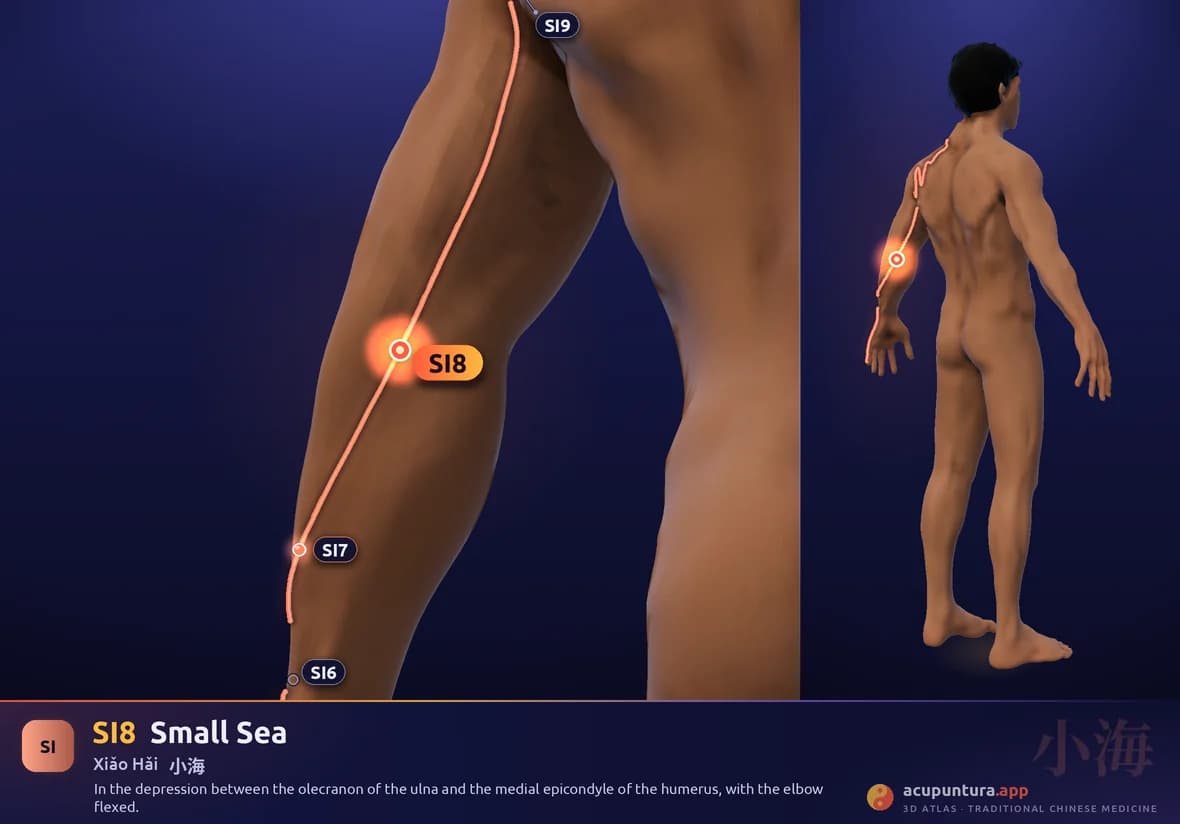
In the depression between the olecranon of the ulna and the medial epicondyle of the humerus, with the elbow flexed.
Main function
Clears Heat, relieves elbow and arm pain, calms the Shen.
- He-Sea point (Earth)
- Sedation Point
Therapeutic indications
- Elbow pain
- shoulder pain
- tinnitus
- headache
- Elbow pain along the ulnar course
- Numbness of the little finger
- Epilepsy
- Swelling of the cheek
- Neck pain
- Scrofula
Ryodoraku
- Sedation of Small Intestine
Name and classical tradition
Xiaohai, 小海, is the “small sea.” 小 is small, and 海, the sea. It is the He-Sea point (合穴) of the Small Intestine, the place where, according to the doctrine of the five transport points, the Qi that has traveled the channel from the tip of the finger enters like a river into the sea. On the Yang channels, the He corresponds to Earth. This is the standard reading, consistent with theory, and the Lingshu (Spiritual Pivot) records it in the Ben Shu chapter (本輸).
The main caution is not to confuse it with HT3, Shaohai, the He-Sea point of the Heart. Both names use 海, both allude to a sea of reduced size, their pinyin is very similar, and both points are at the elbow, relatively close together. But the first character is different, 小, “small,” versus 少, “young” or “scarce,” and so are the channels. Xiaohai is in the hollow between the olecranon and the medial epicondyle of the humerus, with the elbow slightly flexed.