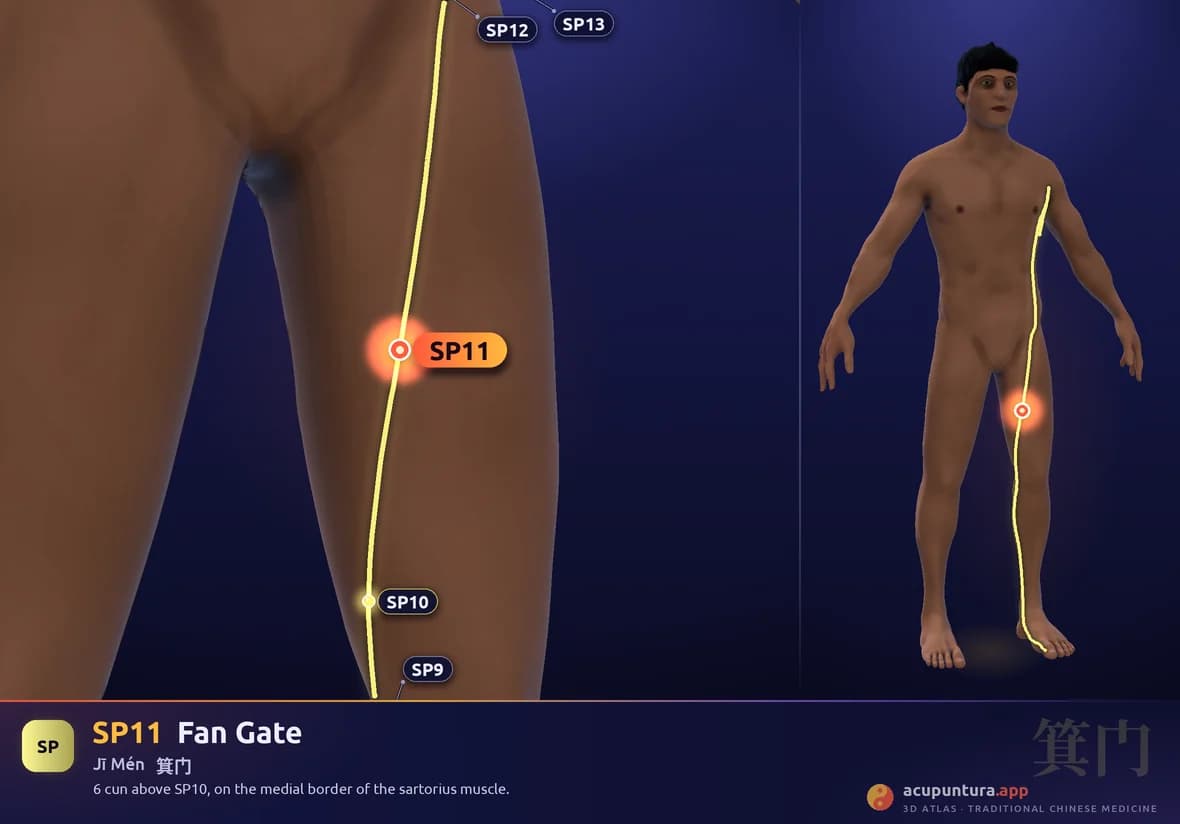
Spleen Channel
Fan Gate
箕门Jī MénAnatomical location
6 cun above SP10, on the medial border of the sartorius muscle.
Main function
Regulates the Qi and Blood of the Lower Jiao, promotes diuresis.
Therapeutic indications
- Groin pain
- dysuria
- pelvic pain
- edema of the groin
- enuresis
- thigh pain
Name and classical tradition
Jimen, 箕门, is the “Winnowing Basket Gate.” 箕 was the shovel-shaped open bamboo basket used to winnow grain; 门 (門) is the gate. The most repeated reading is postural: seated on the floor with the legs apart, the body forms the open shape of that basket, and the point, on the inner thigh, lies in that opening. It is plausible given the location. Another modern reading sees in 箕 the tool that carries earth, an allusion to the Spleen, with no classical citation.
The Zhenjiu Jiayi Jing (Systematic Classic of Acupuncture and Moxibustion) locates it “在魚腹上越兩筋間,動脈應手”: above the “fish belly,” between the two tendons, where the pulse can be felt under the fingers. The “fish belly” is an image for the muscular bulge of the thigh. The quotation has the characteristic phrasing of the Jiayi Jing, although it has not been checked against a critical edition. A secondary source mentions that Sun Simiao’s Qianjin Yifang (Supplement to the Formulas of a Thousand Gold) expanded its indications, a claim that has not been verified.