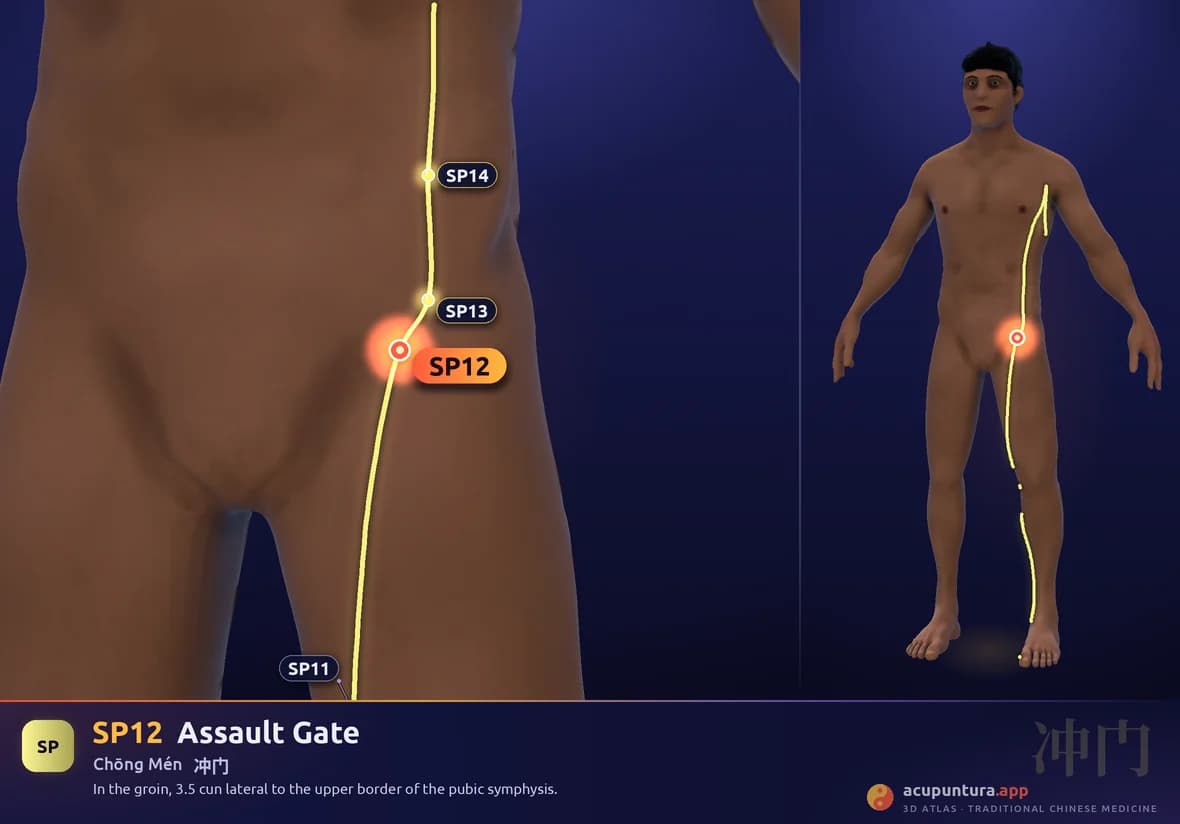
Spleen Channel
Assault Gate
冲门Chōng MénAnatomical location
In the groin, 3.5 cun lateral to the upper border of the pubic symphysis.
Main function
Regulates the Chong Mai, harmonizes the Spleen and Liver, relieves pain.
- Crossing point with the Chong Mai
Therapeutic indications
- Groin pain
- abdominal pain
- menstrual disorders
- hernia
- difficulty urinating
- hemorrhoids
Name and classical tradition
Chongmen, 冲门, is the “Surging Gate.” 冲 refers to an obligatory, strategic passage, and also to the impulse to advance with force; 门 is the gate. The point lies in the groin, in the area the classics called 氣街 (Qi Street), a crucial passage between the trunk and the leg. Hence the reading of a gate on a main thoroughfare. A modern gloss adds that the Qi rising through the leg surges here toward the abdomen, with no citation to support it.
Secondary sources attribute it to the Zhenjiu Jiayi Jing (Systematic Classic of Acupuncture and Moxibustion) and consider it a crossing point of the Spleen channel with the Liver channel. They also record two alternative names, 慈宫, “Palace of Compassion,” and 上慈宫, which sources repeat consistently although without any ancient citation.
Despite sharing the character 冲, Chongmen is not the Chong Mai, the Extraordinary Vessel. In the same inguinal area, the Stomach channel has ST30, Qichong, which tradition regards as the origin of that vessel.
Other names
- 慈宮Jiayi Jing