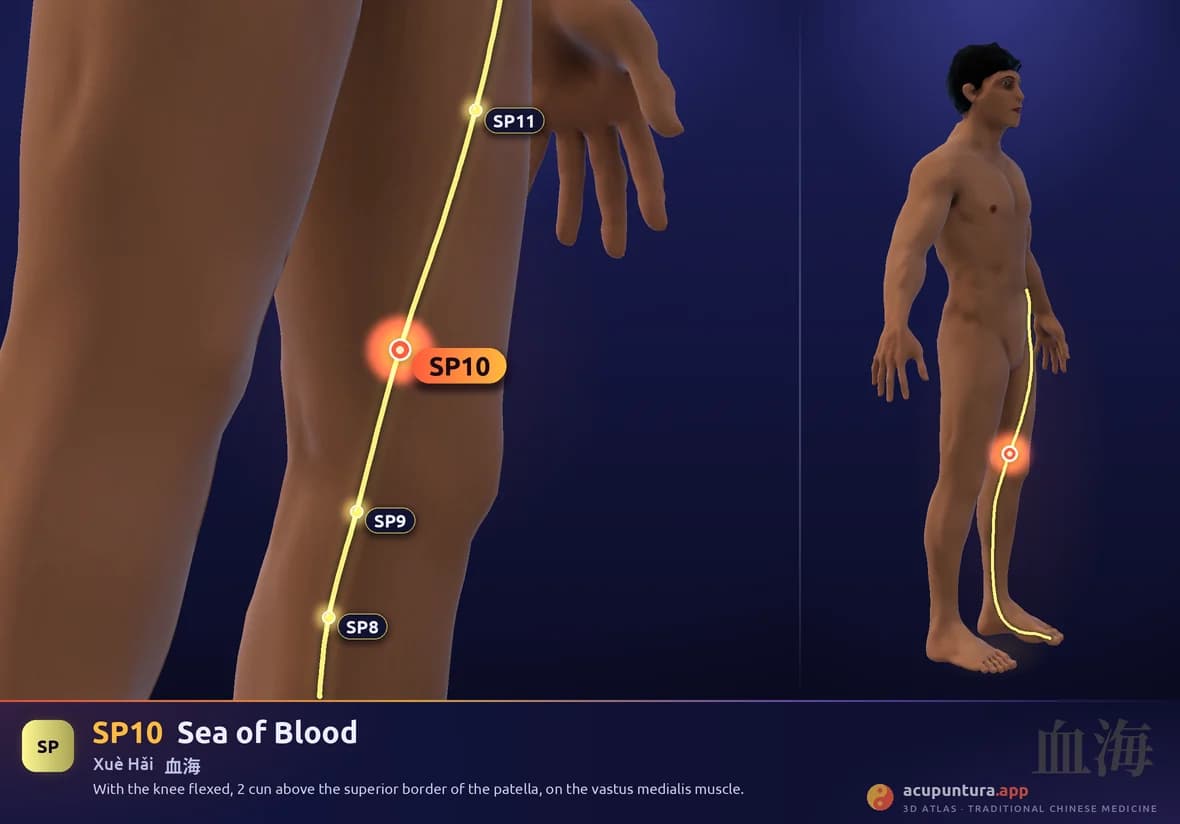
Spleen Channel
Sea of Blood
血海Xuè HǎiAnatomical location
With the knee flexed, 2 cun above the superior border of the patella, on the vastus medialis muscle.
Main function
Regulates the Blood, strengthens the Spleen, eliminates Wind-Dampness.
Therapeutic indications
- Dysmenorrhea
- amenorrhea
- urticaria
- eczema
- knee pain
- Irregular menstruation
- Metrorrhagia
- Eczema
- Pruritus
- Psoriasis
- Pain of the medial thigh
- Heat in the Blood
- Endometriosis
- Knee osteoarthritis
- Atopic dermatitis
- Alopecia areata
- Acne
Name and classical tradition
Xuehai, 血海, is the “Sea of Blood.” Two things that are often confused should be kept apart. The term 血海 appears before the point does, in the Lingshu (Spiritual Pivot), in the chapter Hai Lun (海論, Discourse on the Seas), which describes the four seas of the body: those of marrow, Qi, grain, and Blood. There, the Sea of Blood is the Chong Mai (Penetrating Vessel). That explains the concept, but it does not document the name of this point, which is first recorded as a specific location on the knee in the Zhenjiu Jiayi Jing (Systematic Classic of Acupuncture and Moxibustion).
The explanation textbooks give is that the Spleen governs the Blood (脾統血) and that so much of it gathers here that the point is compared to a sea. This is a gloss with no classical citation for this point. The Jiayi Jing does assign it an indication along those lines: “若血闭不通,逆气胀,血海主之”—Xuehai governs blocked Blood that does not circulate, with rebellious Qi and distension. The text reaches us through a secondary source and has not been checked against a critical edition.
Its alternative names are 血郄, “Cleft of the Blood,” and 百虫窠, “Nest of the Hundred Insects.” In modern glosses, the latter is linked to the Dampness and Summer-Heat of the long summer, the season of insects, a reading with no citation. In later tradition, the point came to be associated with skin and gynecological disorders related to the Blood.