Spleen Channel
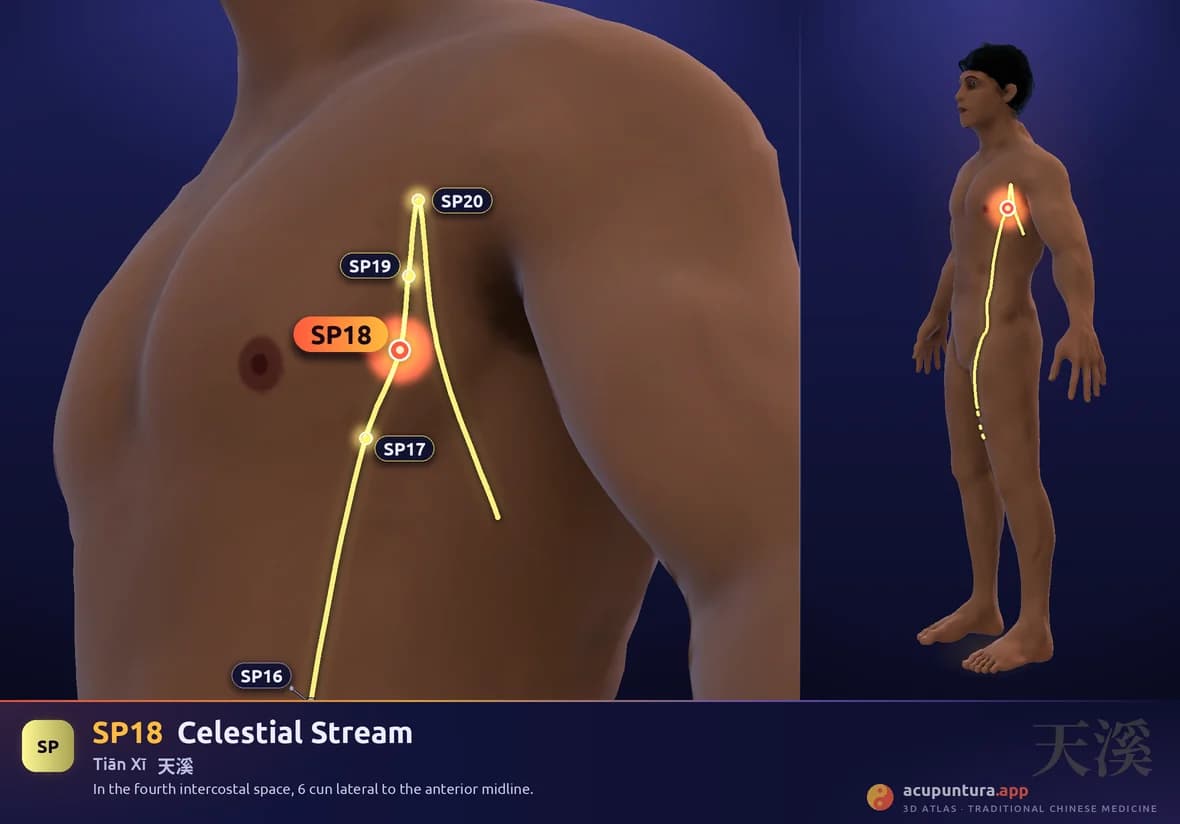
Celestial Stream
天溪Tiān XīAnatomical location
In the fourth intercostal space, 6 cun lateral to the anterior midline.
Main function
Regulates the Qi of the chest, promotes lactation, relieves cough.
Therapeutic indications
- Chest pain
- mastitis
- agalactia
- cough
- scanty milk
- hiccups
Name and classical tradition
Tianxi, 天溪, is the “Celestial Stream.” 天 indicates the upper part of the body, here the thorax; 溪 is the stream, the channel between landforms, which in this case are the ribs. A modern gloss explains that damp Qi rising from SP17 warms up and flows through this channel toward the upper chest. It has no classical support.
It is one of the points on the channel with the least historical information. Sources refer it back to the Zhenjiu Jiayi Jing (Systematic Classic of Acupuncture and Moxibustion), without a literal citation. Many points on other channels share the character 溪, such as KI3, Taixi, or LI5, Yangxi, but this is only the same stream metaphor, with no relationship among them.