Spleen Channel
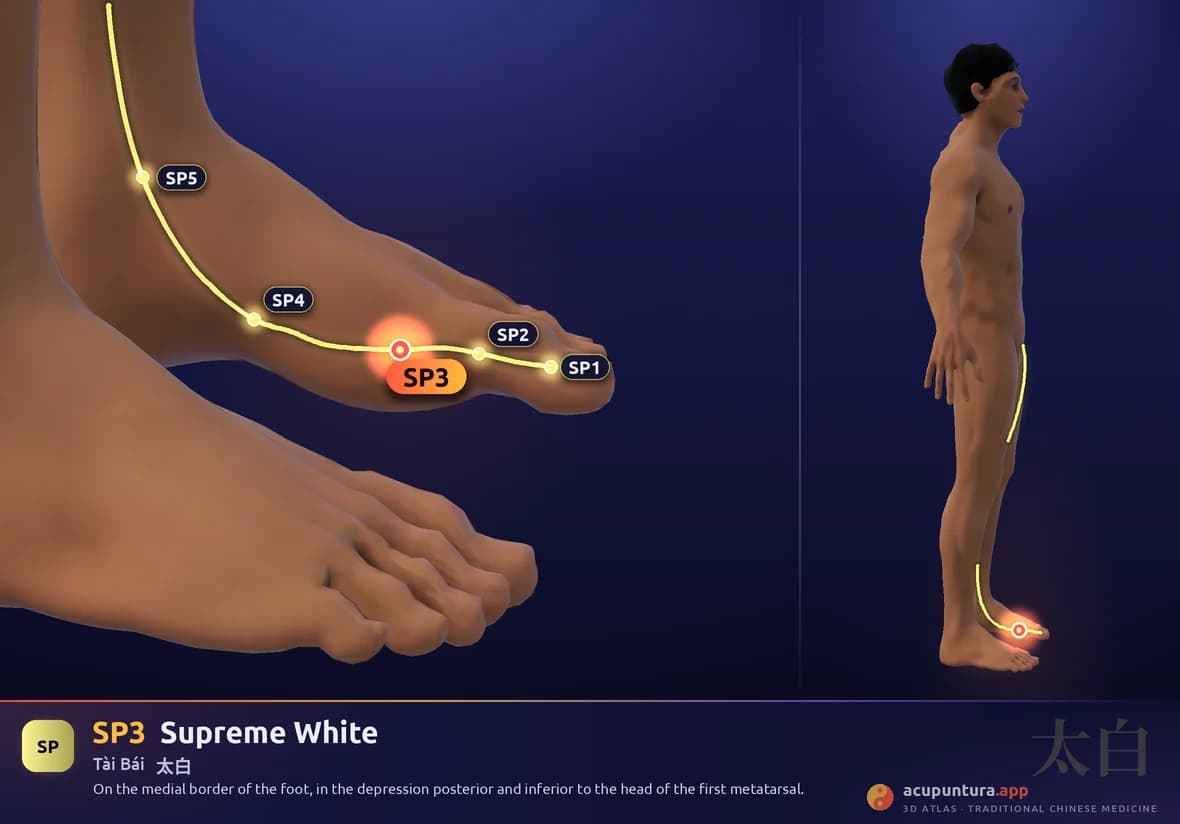
Supreme White
太白Tài BáiAnatomical location
On the medial border of the foot, in the depression posterior and inferior to the head of the first metatarsal.
Main function
Strengthens the Spleen, harmonizes the Stomach, transforms Dampness, lifts the Yang.
- Yuan (Source) point
- Shu-Stream point (Earth)
- Ryodoraku point F1 (Spleen)
Therapeutic indications
- Abdominal pain
- diarrhea
- constipation
- fatigue
- organ prolapse
- Abdominal distension
- Gastric pain
- Vomiting
- Borborygmi
- Hemorrhoids
- Heaviness of the body
- Joint pain
- Poor appetite
- Obsessive disorder (ruminative thinking)
- Diabetes mellitus (Xiao Ke)
- Obesity and overweight
- Hyperlipidemia (high cholesterol and triglycerides)
Ryodoraku
F1BazoMeasurement point no. 4
Yuan-Source point of the Spleen, medial border of the foot.
Name and classical tradition
Taibai (太白) is the name ancient Chinese astronomy gave to the planet Venus, the morning star, also called 太白星 or 太白金星. The astronomical reading is the one recorded in the specialist reference Yibian, and it comes with an observation that can be checked. In the Lingshu (Spiritual Pivot), the Yuan-Source points of the five Zang organs all carry 太 or 大 in their names: LU9, Taiyuan, of the Lung; PC7, Daling, which the Lingshu assigns to the Heart; LR3, Taichong, of the Liver; KI3, Taixi, of the Kidney; and Taibai, of the Spleen. The name belongs to the same family.
There is another reading, in the style of modern glosses: 白 is the white of Metal, and the Earth point of the Spleen would generate Metal, hence its color. It has no classical citation. Nor should it be confused with Mount Taibai (太白山) of the Daoist tradition, which has no relation to the point.
The Lingshu, in the Ben Shu (本輸) chapter, says: “注於太白,太白,腕骨之下也,為俞”. Qi flows into Taibai, below the bone; it is the Shu-Stream point (輸穴). On the Yin channels, the Shu-Stream point is also the Yuan-Source point and corresponds to Earth, the Spleen's own phase. Yang Shangshan specified the bony landmark in the Huangdi Neijing Taisu: the point lies next to the bony prominence behind the large joint of the big toe. The Zhenjiu Jiayi Jing (Systematic Classic of Acupuncture and Moxibustion), the Shenying Jing, and the Xunjing Kaoxue Bian give slightly different descriptions, and comparing them shows how the exact location was adjusted over the centuries.