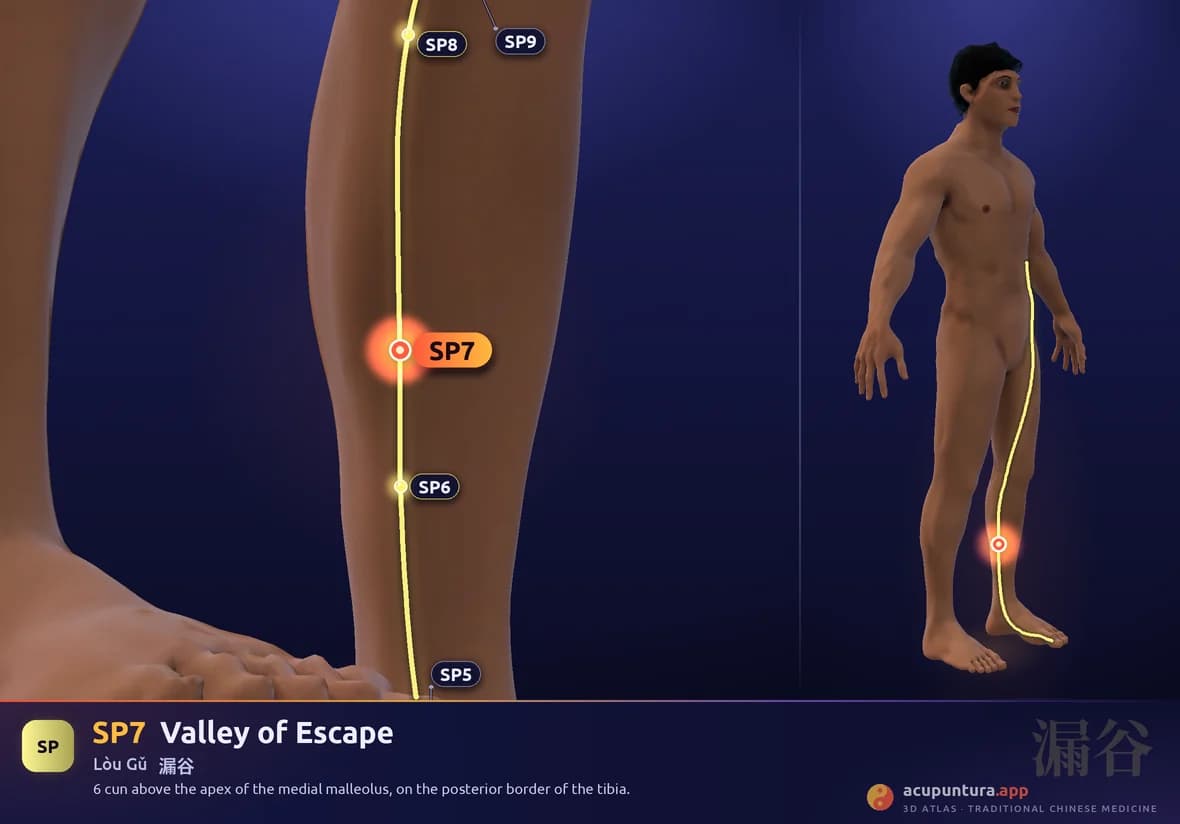
Spleen Channel
Valley of Escape
漏谷Lòu GǔAnatomical location
6 cun above the apex of the medial malleolus, on the posterior border of the tibia.
Main function
Clears Damp-Heat, promotes diuresis, and strengthens the Spleen.
Therapeutic indications
- Edema
- dysuria
- abdominal pain
- diarrhea
- jaundice
- Abdominal distension
- Borborygmi
- Cold and numbness of the leg
Name and classical tradition
Lougu (漏谷) is the “leaking valley.” 漏 means leak, drip, seepage; 谷 is valley, which in classical nomenclature designates the large separations between muscle masses. The point is on the inner side of the leg, at the edge of the tibia, six cun above the malleolus.
The explanation of the name comes from a Qing-dynasty commentator, Cheng Fusheng, in his Yijing Lijie (醫經理解): “謂有漏而別走者也”, which refers to a leak that diverts along another path. It is a late source, but it is a real commentator and not an anonymous modern gloss. Like so many points of the trunk, it enters the written tradition with the Zhenjiu Jiayi Jing (Systematic Classic of Acupuncture and Moxibustion).
It is worth stressing what Lougu is not. Although its name speaks of something that diverts, the Luo-Connecting point of the Spleen, the one that splits off toward the Stomach channel, is SP4, Gongsun, as the Lingshu (Spiritual Pivot) establishes in the Jing Mai chapter.