Spleen Channel
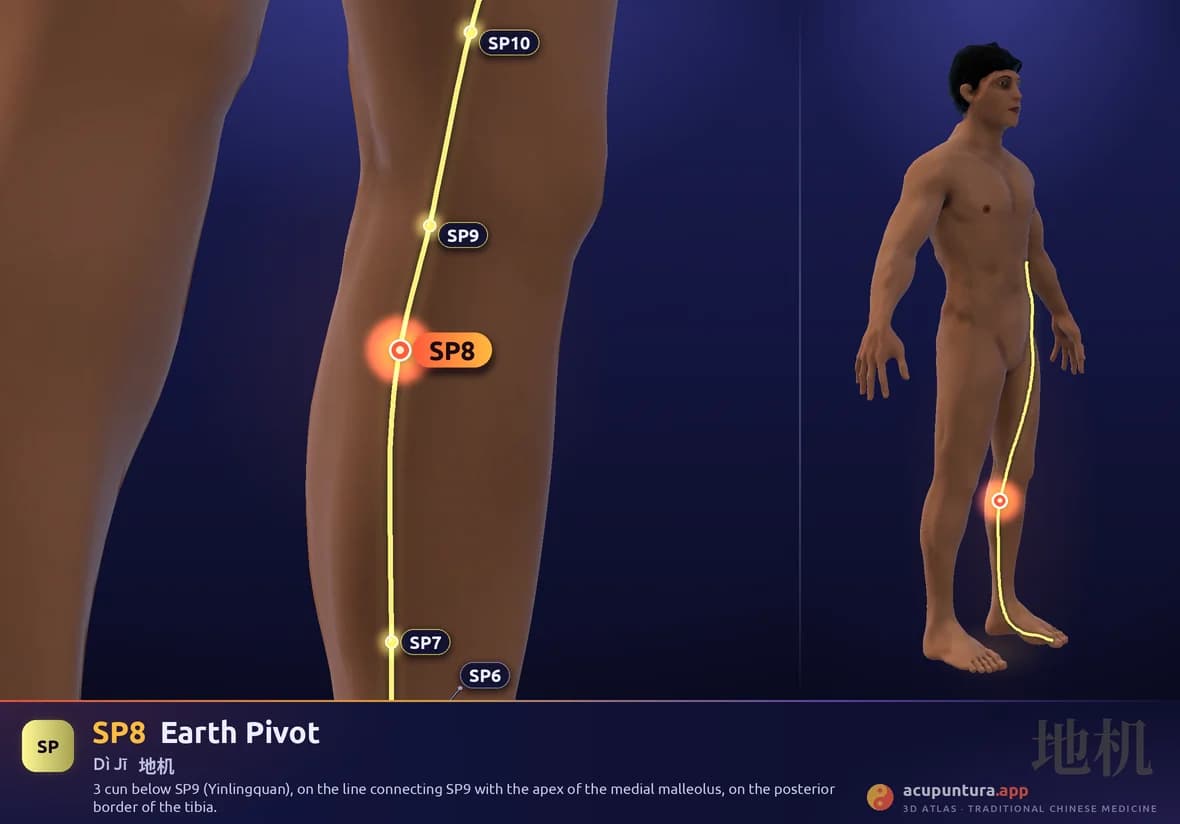
Earth Pivot
地机Dì JīAnatomical location
3 cun below SP9 (Yinlingquan), on the line connecting SP9 with the apex of the medial malleolus, on the posterior border of the tibia.
Main function
Regulates the Blood, strengthens the Spleen, eliminates Dampness, relieves pain.
- Xi-Cleft point
Therapeutic indications
- Dysmenorrhea
- abdominal pain
- diarrhea
- edema
- Irregular menstruation
- Acute abdominal pain
- Dysuria
- Lumbosacral pain
- Ménière's disease
- Venous insufficiency and varicose veins
Name and classical tradition
Diji (地机) is the “mechanism of the earth.” 地 is earth, which here can be read as the Spleen, the organ of the Earth phase; 机 (機), the mechanism, the gearwork, the crucial point on which a movement depends. A modern gloss speaks of the Spleen's earth being carried through this point by an ingenious mechanism. It is an interpretation with no classical citation.
Diji is the Xi-Cleft point (郄穴) of the Spleen, the point of deep accumulation that the tradition uses in acute conditions. Attributing its origin to the Zhenjiu Jiayi Jing (Systematic Classic of Acupuncture and Moxibustion) is probable, although the citation has not been verified.
It has two alternate names. 地箕 replaces 機 with 箕, the basket used to carry earth or to winnow grain, a variant that preserves the image of working with earth. The other, 脾舍, “dwelling of the Spleen,” can be confused with SP13, Fushe, whose official name shares the character 舍 and a similar meaning. They are two distinct points.
Other names
- 脾舍Jiayi Jing