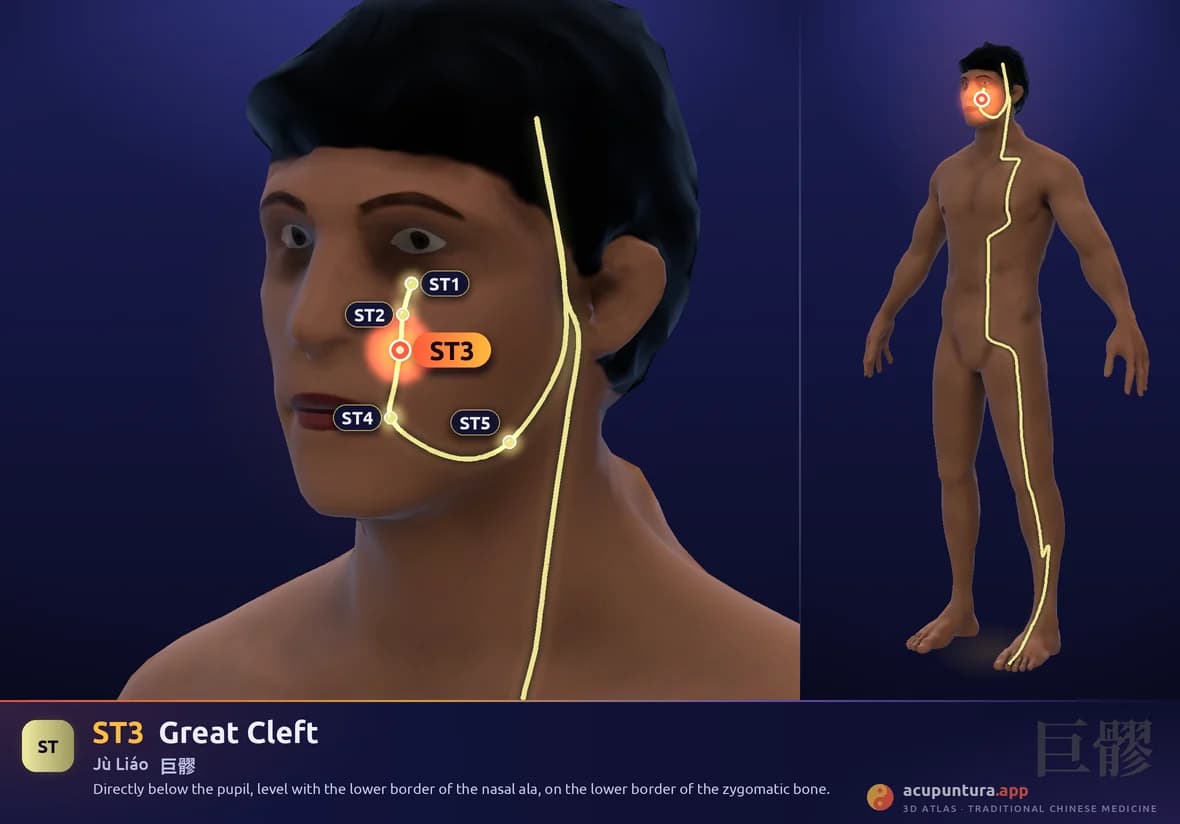
Stomach Channel
Great Cleft
巨髎Jù LiáoAnatomical location
Directly below the pupil, level with the lower border of the nasal ala, on the lower border of the zygomatic bone.
Main function
Disperses Wind, benefits the face, relieves facial pain, opens the nasal orifices.
Therapeutic indications
- Deviation of the mouth
- eyelid spasm
- facial pain
- epistaxis
- toothache
- facial paralysis
- swelling of the lips and cheeks
- sinusitis
- corneal opacity
- trigeminal neuralgia
Name and classical tradition
Juliao, 巨髎, is the “great hollow.” 巨 means large; 髎 is the hollow or cleft beside a bone, the same character found in many points located in bony depressions, such as GB1 or GB29. The point sits beside the ala of the nose, in the fossa the maxilla forms below the cheekbone, and the name describes it plainly.
Alongside this anatomical reading, a modern one in the style of the qi-vapor interpretations speaks of turbid Qi that turns into cold rain and falls to the earth. No ancient commentary supports it.
The first work to record the point is the Zhenjiu Jiayi Jing (Systematic Classic of Acupuncture and Moxibustion), and the sources agree that it is a crossing point of the hand and foot Yangming with the Yang Qiao Mai. It should not be confused with its partial namesake at the hip, Juliao of the Gallbladder, GB29, which is written with a different first character, 居.