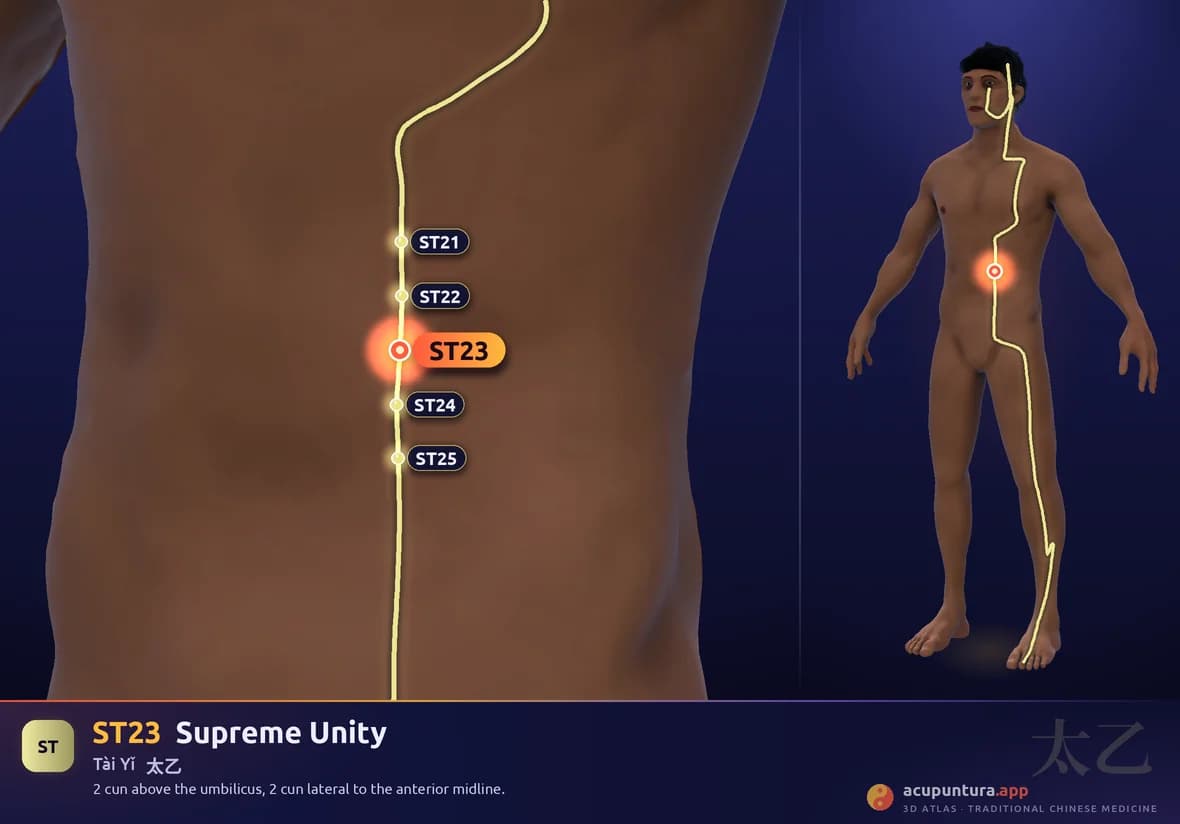
Stomach Channel
Supreme Unity
太乙Tài YǐAnatomical location
2 cun above the umbilicus, 2 cun lateral to the anterior midline.
Main function
Regulates the Stomach, calms the mind, transforms Phlegm, relieves abdominal pain.
Therapeutic indications
- Abdominal pain
- vomiting
- loss of appetite
- insomnia
- agitation
- gastric pain
- indigestion
- mental agitation
- mania
- epilepsy
Name and classical tradition
Taiyi (太乙) has one of the most enigmatic names on the channel. 太乙, also written 太一, was in ancient Chinese cosmology the name of the Great One, the astral deity who dwelt in the pole star at the center of the sky. The Shiji (Records of the Grand Historian) of Sima Qian, in the treatise on the celestial offices (天官書), puts it this way: “中宮天極星,其一明者,太一常居也”. In the central palace is the star of the celestial pole; the brightest of them is the permanent dwelling of Taiyi. The Huainanzi specifies his residence: “紫宮者,太一之居也”, the Purple Palace is the home of Taiyi. That palace also has its point in the body, on the chest at the Ren Mai (Conception Vessel): CV19, Zigong.
Why a point on the abdomen, two cun above the umbilicus, should be named for that deity is something no ancient text explains. The Shiji quotation clarifies what 太乙 meant, not why it was applied to this point. It may follow the custom of naming points after stars and deities, of which the Stomach channel has another example in ST40, Fenglong; any functional explanation given today is a modern gloss.
In the Zhenjiu Jiayi Jing (Systematic Classic of Acupuncture and Moxibustion) it appears in the book of indications alongside its neighbor: “狂癲疾,吐舌,太乙及滑肉門主之”, madness and epilepsy with the tongue protruding are treated with Taiyi and Huaroumen, ST24. It belongs to the epigastric series, between ST22 and ST24.