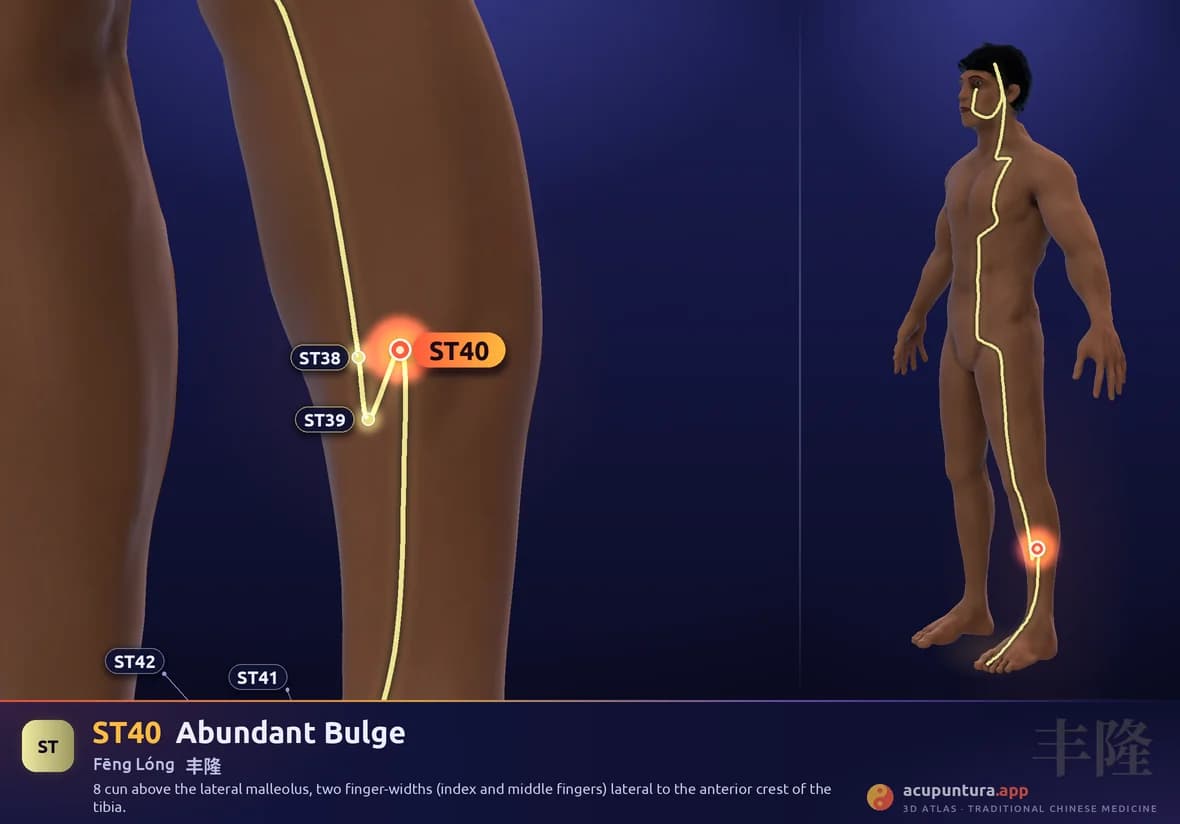
Stomach Channel
Abundant Bulge
丰隆Fēng LóngAnatomical location
8 cun above the lateral malleolus, two finger-widths (index and middle fingers) lateral to the anterior crest of the tibia.
Main function
Transforms Phlegm, regulates Qi, calms cough, relieves pain.
- Luo (Connecting) point
Therapeutic indications
- Cough with phlegm
- asthma
- headache
- dizziness
- leg pain
- profuse expectoration
- chest oppression
- mania
- epilepsy
- constipation
- edema
- headache
- sensation of a foggy head
- schizophrenia (Dian Kuang)
- bipolar disorder (alternating Dian-Kuang)
- acute psychosis
- obsessive disorder (ruminative thinking)
- depression
- cognitive decline and dementia
- Ménière's disease
- addictions and smoking cessation
- diabetes mellitus (Xiao Ke)
- obesity and overweight
- hyperlipidemia (high cholesterol and triglycerides)
- fatty liver
- COPD and chronic bronchitis
- polycystic ovary syndrome
- acne
Name and classical tradition
Fenglong, 丰隆, bears the name of a god. In the mythology of ancient China, 豐隆 was the lord of clouds and rain, and later tradition also made him the god of thunder. In the Li Sao, the great poem by Qu Yuan, the poet gives him orders: «吾令豐隆椉雲兮,求宓妃之所在», I command Fenglong to ride the clouds and search for where the goddess Fufei lives. The Huainanzi (Master of Huainan), in its treatise on astronomy, puts him at the service of the calendar: «季春三月,豐隆乃出,以將其雨», in the third month of spring Fenglong comes out, bringing the rain. The name of the point is therefore neither anatomical nor functional, but taken from the sky, like that of ST23, Taiyi.
Its natural partner is LU7, Lieque, whose name in classical Chinese meant lightning. And the pairing is not a modern invention: Sima Xiangru, in the Poem of the Great Man (Rhapsody on the Great Man) preserved in the Hanshu (Book of Han), joins them in two consecutive lines, «貫列缺之倒景兮,涉豐隆之滂濞», crossing the reflection of Lieque, wading through the downpour of Fenglong. Ying Shao's commentary clarifies who is meant: «豐隆,雲師也», Fenglong is the master of the clouds. Both are, moreover, Luo-Connecting points (絡穴), the places where a channel communicates with its paired channel: lightning and rain, the two arms of the storm. No ancient medical commentary states the relationship, but the two names come from the same poetic vocabulary of the sky.
What is canonical medical text is its function. The Lingshu (Spiritual Pivot), in the chapter Jing Mai (經脈), the one that lists the collaterals of all the channels, names Fenglong as the Luo of the Stomach, the point from which the channel communicates with that of the Spleen.