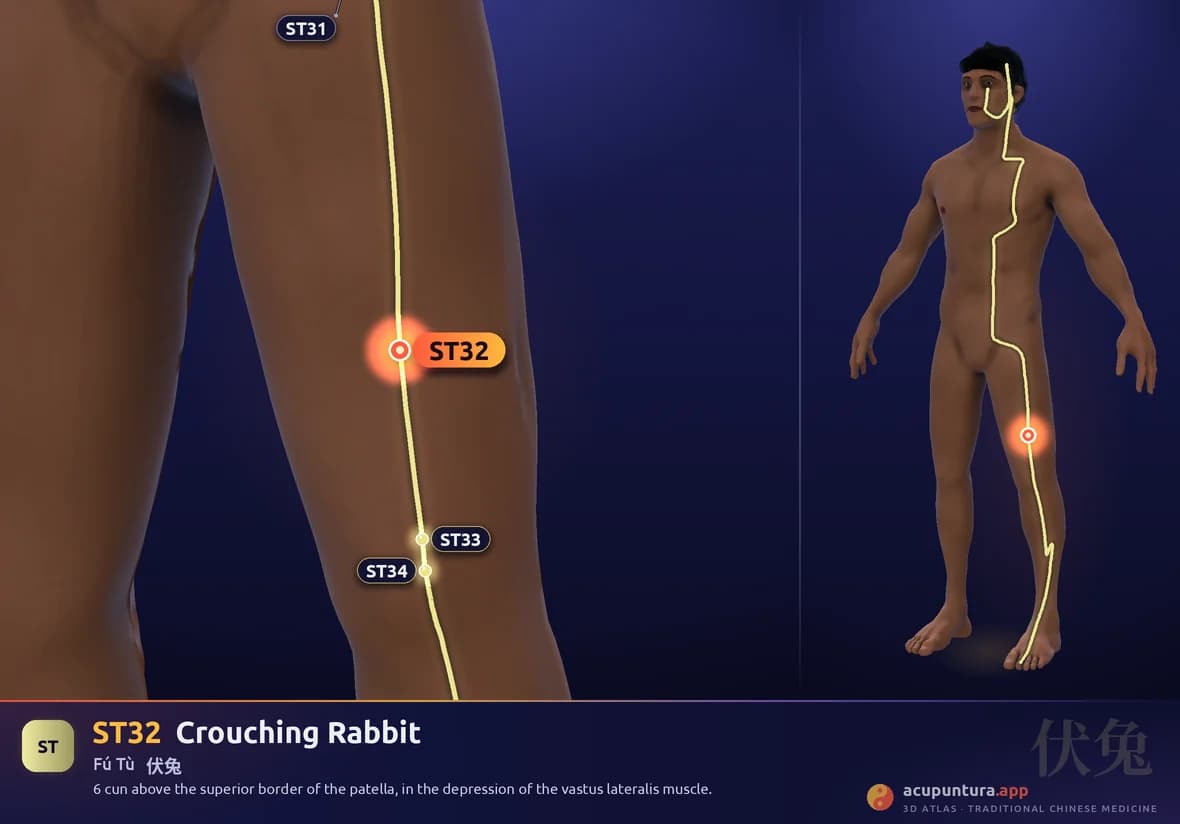
Stomach Channel
Crouching Rabbit
伏兔Fú TùAnatomical location
6 cun above the superior border of the patella, in the depression of the vastus lateralis muscle.
Main function
Disperses Wind-Dampness, benefits the knee and thigh, relieves pain.
Therapeutic indications
- Knee pain
- thigh pain
- paralysis of the lower limb
- sciatica
- pain and coldness of the knee and thigh
- paralysis of the lower limb
- leg weakness
Name and classical tradition
Futu (伏兔) is the “crouching rabbit,” one of the most graphic images on the channel. 伏 means to lie low, hidden; 兔 is the rabbit or hare. The explanation comes from the Huiyuan Zhenjiu Xue, a twentieth-century systematic work that gathers the anatomical tradition: “伏兔者,伏是潛伏,大腿肉肥如兔,跪時肉起如兔之潛而不伏也,故名伏兔.” The character 伏 means to crouch; the thigh is fleshy like a rabbit, and when kneeling the muscle rises like a rabbit that, crouched, tenses up. The mass of the quadriceps is that rabbit. The image is vivid and coherent, although the source is late and not an ancient commentator.
The term is older than the point. In the Lingshu (Spiritual Pivot), chapter Jing Mai (經脈), 伏兔 appears as an anatomical landmark along the course of the Stomach channel, where the channel passes before descending to the knee. As with ST12, the name of the point seems to come from the region. The Zhenjiu Jiayi Jing (Systematic Classic of Acupuncture and Moxibustion) in turn uses it to locate ST31, and counts it among the few points forbidden to both needle and moxa: “伏兔禁不可刺” and “伏兔禁不可灸.”