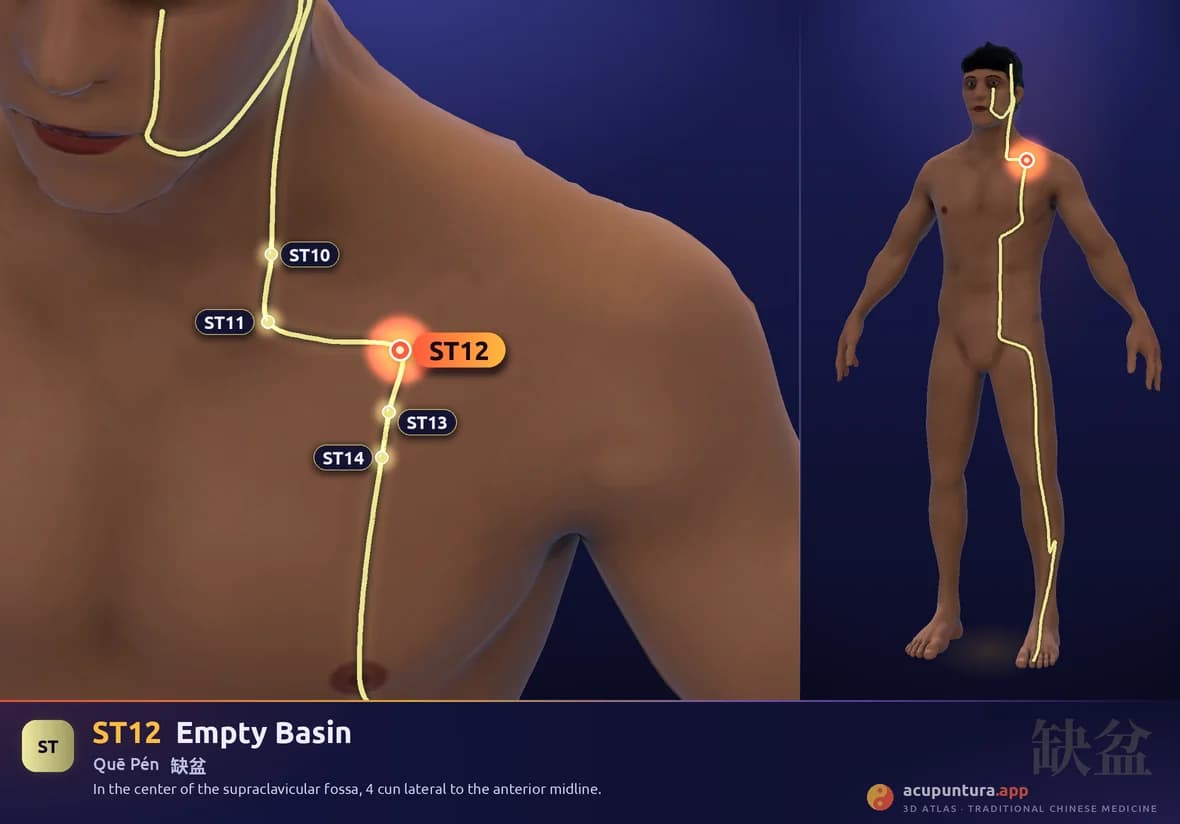
Stomach Channel
Empty Basin
缺盆Quē PénAnatomical location
In the center of the supraclavicular fossa, 4 cun lateral to the anterior midline.
Main function
Regulates Qi, descends rebellious Qi, benefits the chest, relieves cough and asthma.
Therapeutic indications
- Cough
- asthma
- chest pain
- shoulder pain
- sore throat
- supraclavicular pain
- scrofula
- hiccups
Name and classical tradition
Quepen, 缺盆, is the “broken bowl.” 缺 means broken, chipped; 盆, bowl, vessel. The supraclavicular fossa, the hollow above the clavicle, has the shape of a bowl with a broken rim, and the name describes it literally. In this case the order of events matters: 缺盆 was first the name of a region of the body, and the point took its name from it.
The Lingshu (Spiritual Pivot) uses the term frequently to describe the pathways of the channels. In the chapter Jing Mai (經脈), the Stomach channel itself “enters the quepen” (入缺盆), and other channels also pass through this anatomical crossroads. As the name of a specific point, the origin the sources cite is the Suwen (Basic Questions), chapter Qi Fu Lun (氣府論), which lists it explicitly.
The reference works give it an alternative name, 天蓋, “lid of heaven,” the same one given to LI17.
Other names
- 天蓋Jiayi Jing