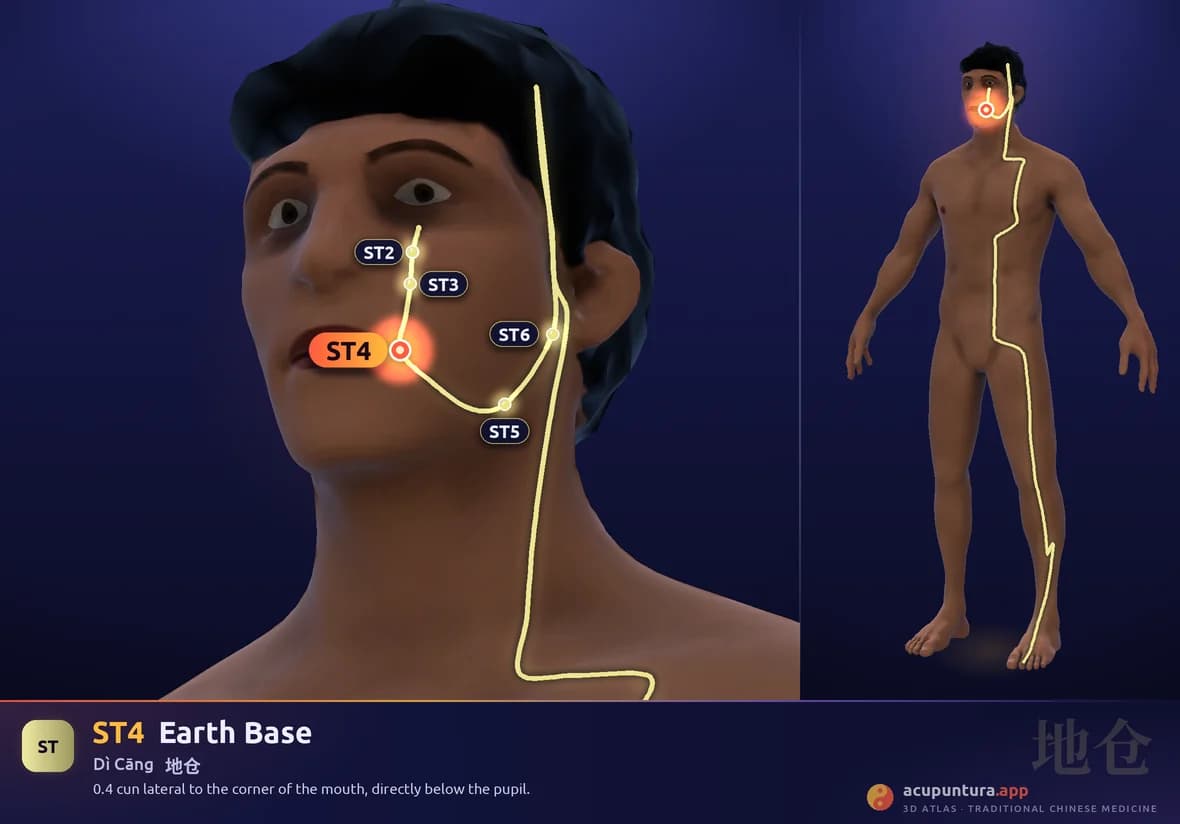
Stomach Channel
Earth Base
地仓Dì CāngAnatomical location
0.4 cun lateral to the corner of the mouth, directly below the pupil.
Main function
Disperses Wind, regulates the local channels, benefits the face, relieves pain.
- Crossing point with the Yang Qiao and Ren Mai
Therapeutic indications
- Deviation of the mouth
- drooling
- eyelid spasm
- facial pain
- facial paralysis
- excessive salivation
- trismus
- facial tic
- difficulty speaking
Name and classical tradition
Dicang, 地仓, is the “granary of the earth.” 地 refers to the traditional division of the face into three levels, heaven, human, and earth, in which the mouth occupies the level of the earth. 仓 (倉 in traditional form) is the granary. The point lies beside the corner of the lips, and the name links this area of the face with the function of the Stomach, which receives the grains.
Secondary sources accompany this reading with a quotation attributed to the Neijing (Inner Classic): “地氣通於口,食五穀必經於口,故名地倉,” that is, the Qi of the earth communicates with the mouth, all grains pass through it, hence the name. The phrase has not been located in the Suwen (Basic Questions) or the Lingshu (Spiritual Pivot), and it may well be a modern paraphrase vaguely alluding to the Suwen. It should therefore be taken as a traditional explanation, not as canonical text.
The first work to record the point is the Zhenjiu Jiayi Jing (Systematic Classic of Acupuncture and Moxibustion). It is a crossing point of the Yang Qiao Mai with the hand and foot Yangming. Its alternative names, 會維 and 胃維, “bond of the Stomach,” reinforce the idea of a meeting place.
Other names
- 會維Jiayi Jing