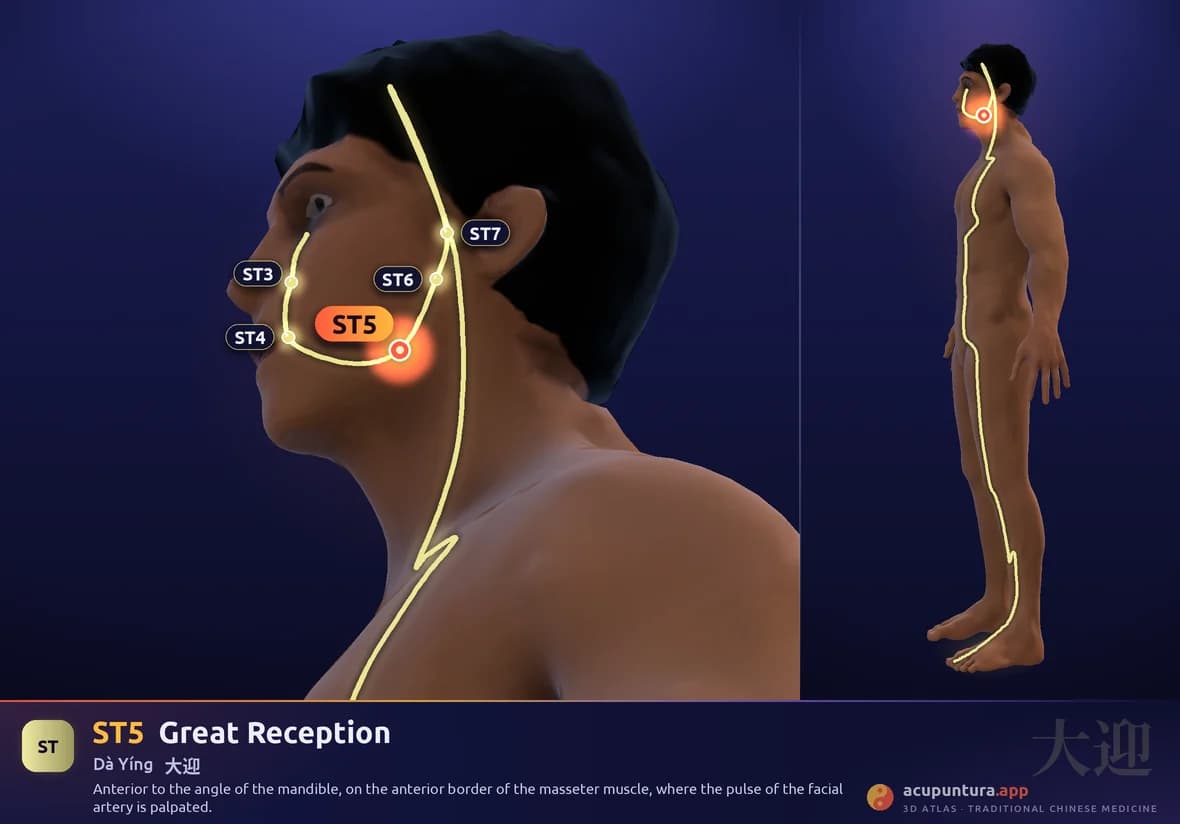
Stomach Channel
Great Reception
大迎Dà YíngAnatomical location
Anterior to the angle of the mandible, on the anterior border of the masseter muscle, where the pulse of the facial artery is palpated.
Main function
Disperses Wind-Heat, benefits the jaw, relieves pain, reduces swelling.
Therapeutic indications
- Toothache
- swelling of the cheek
- trismus
- facial paralysis
- jaw pain
- facial spasm
Name and classical tradition
Daying, 大迎, means “great welcome”: 大, large, much; 迎, to receive, to go out and meet. The explanation in circulation is that the point receives a good share of the channel's Qi and Blood as it rises toward the head. This is a reasonable modern gloss, but it has no classical citation. The point lies on the edge of the mandible, in front of the masseter muscle, where the beat of the facial artery can be felt.
The textual origin of the point is uncertain. Some sources place it in the Lingshu (Spiritual Pivot), chapter Han Re Bing (寒熱病), and others in the Suwen (Basic Questions), chapter Qi Xue Lun (氣穴論). It has not been possible to verify which is correct, although the former is the one cited most often. The reference works give it an alternative name, 髓孔.
Other names
- 髓孔Jiayi Jing