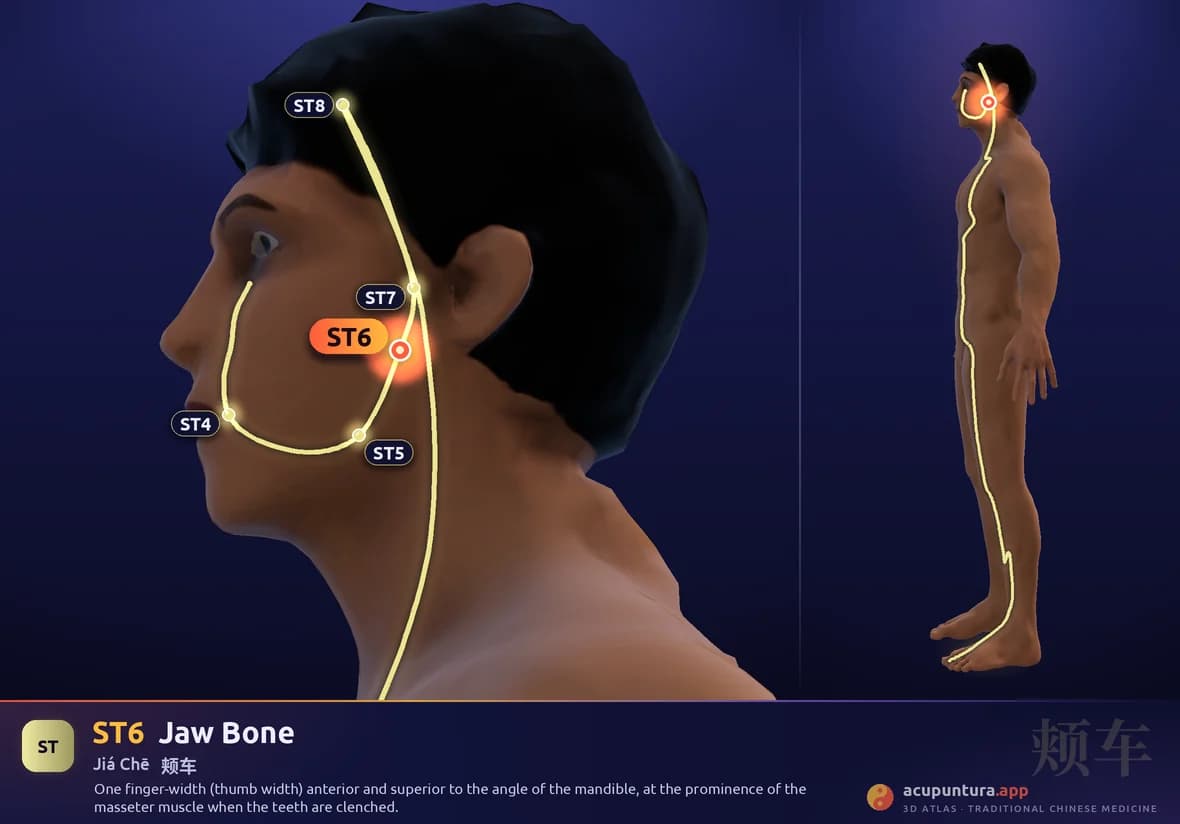
Stomach Channel
Jaw Bone
颊车Jiá ChēAnatomical location
One finger-width (thumb width) anterior and superior to the angle of the mandible, at the prominence of the masseter muscle when the teeth are clenched.
Main function
Disperses Wind-Heat, benefits the jaw, relieves pain, reduces swelling.
Therapeutic indications
- Toothache
- trismus
- jaw pain
- facial paralysis
- swelling of the cheek
- mumps
- mandibular pain
- neck stiffness
- loss of voice
- schizophrenia (Dian Kuang)
- trigeminal neuralgia
- bruxism
Name and classical tradition
Jiache, 颊车, is the “cheek carriage.” 颊 (頰) is the cheek, and 车 (車) is the carriage or the wheel. The point lies at the angle of the mandible, over the masseter, and the traditional reading compares the jaw joint to a wheel that turns as we chew. It is an old interpretation, consistent with the use of 車 and 樞, wheel and pivot, to name mobile joints in the classical texts.
The Zhenjiu Jiayi Jing (Systematic Classic of Acupuncture and Moxibustion) gives a very precise location: “在耳下曲頰端陷者中,開口有孔,” below the ear, in the depression at the curved end of the jaw; a hollow forms when the mouth is opened. Secondary sources also mention the point in the Lingshu (Spiritual Pivot), in the chapters Jing Mai (經脈) and Xie Qi Zang Fu Bing Xing (邪氣臟腑病形).
Its alternative names are of historical interest. 曲牙, “curved tooth,” is attributed to the Suwen (Basic Questions), in the chapter Qi Xue Lun, which lists several points by their ancient names. 機關, “mechanism,” and 鬼床, “bed of the spirits,” are attributed to Sun Simiao's Qianjin Yifang from the Tang period; the second corresponds to the seventh of the thirteen ghost points of the Qianjin Yaofang (Essential Formulas Worth a Thousand Gold), “耳前髮際宛宛中,耳垂下五分,名鬼床,” in front of the ear, below the lobe, called the “bed of the spirits.” 齒牙, 鬼林, and 臼關 are also listed.