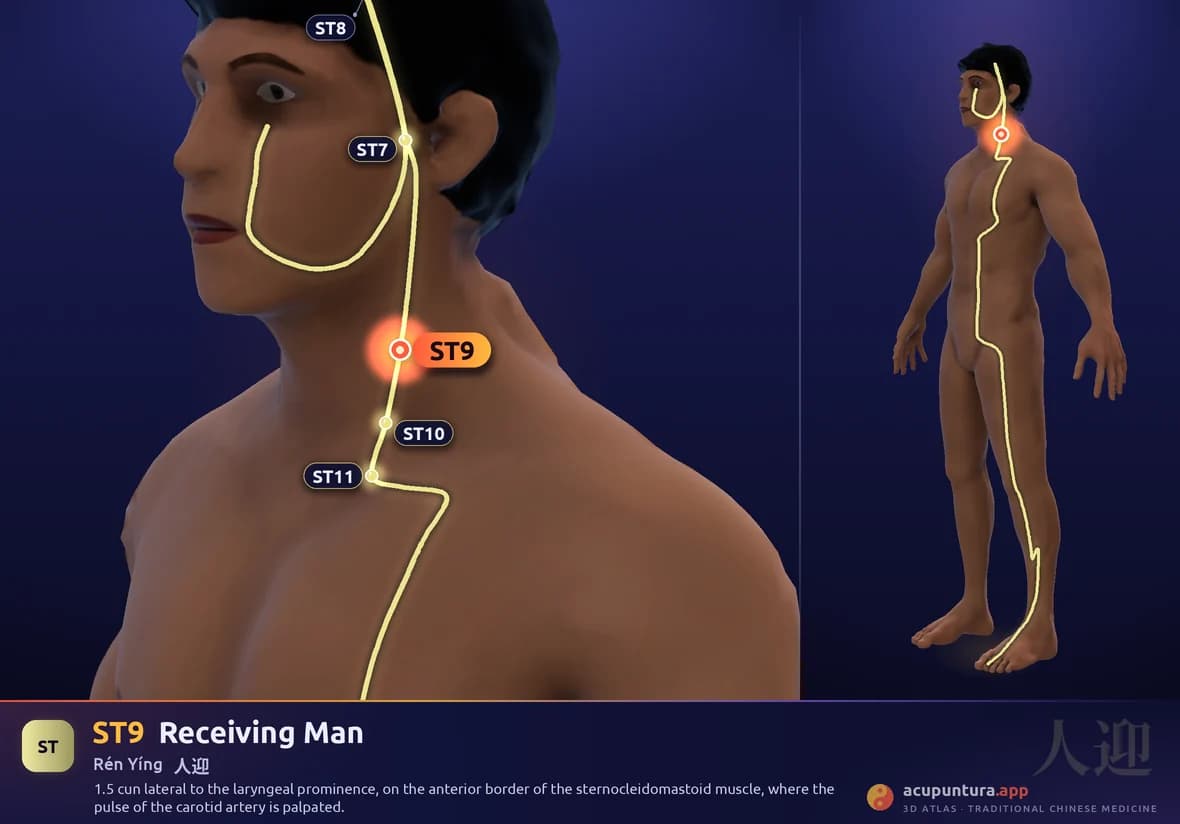
Stomach Channel
Receiving Man
人迎Rén YíngAnatomical location
1.5 cun lateral to the laryngeal prominence, on the anterior border of the sternocleidomastoid muscle, where the pulse of the carotid artery is palpated.
Main function
Regulates Qi, benefits the throat, descends rebellious Qi, disperses Wind.
- Window of Heaven point
- Crossing Point with the Gallbladder
Therapeutic indications
- Sore throat
- hoarseness
- goiter
- asthma
- hypertension
- dizziness
- facial flushing
- scrofula
- hypothyroidism
- hyperthyroidism
Name and classical tradition
Renying, 人迎, is one of the best-explained point names on the channel, because it has a gloss from an identified classical commentator. 人 is the human being; 迎, to welcome, to receive. Yang Shangshan, in the seventh century, explains it in the Huangdi Neijing Taisu (Grand Basis of the Yellow Emperor's Inner Classic): “在二結喉兩箱,足陽明脈迎受五臟六腑之氣以養於人,故曰人迎.” It lies on both sides of the Adam's apple; there the foot Yangming channel receives the Qi of the five Zang organs and the six Fu organs to nourish the person, and that is why it is called Renying.
The point already appears in the Lingshu (Spiritual Pivot), in the chapter Ben Shu (本輸), among the fundamental points of the neck. Its historical interest goes beyond acupuncture. In the Neijing (Inner Classic), the artery that beats at this site was palpated to compare its pulse with that of the wrist, the cunkou: the diagnostic method that sets Renying against Cunkou (人迎寸口). From the oldest texts, then, the point had a diagnostic role as well as a therapeutic one.
The Zhenjiu Jiayi Jing (Systematic Classic of Acupuncture and Moxibustion) confirms both in a single entry: “人迎,一名天五會,在頸大脈動應手,俠結喉,以候五臟氣,” Renying, also called Tianwuhui, “the celestial meeting of the five,” lies over the great pulsation of the neck, on either side of the Adam's apple, and serves to assess the Qi of the five Zang organs. And it warns: “禁不可灸,刺入四分,過深不幸殺人,” moxa is not applied; needle four fen, and if you go too deep, it can kill. On the neck, its immediate neighbors are ST10 and, from the Large Intestine channel, LI18.
Other names
- 天五會Jiayi Jing