Triple Energizer Channel
Ear Harmony
和髎Hé LiáoAnatomical location
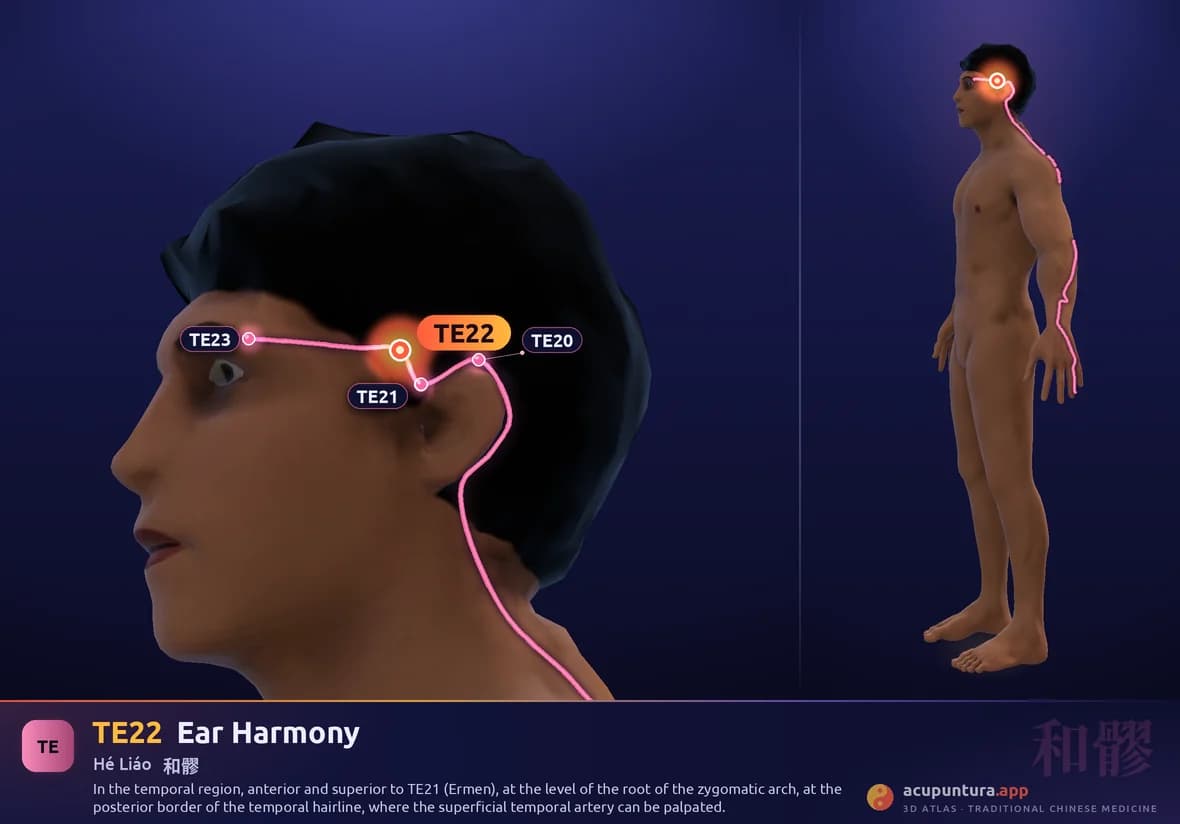
In the temporal region, anterior and superior to TE21 (Ermen), at the level of the root of the zygomatic arch, at the posterior border of the temporal hairline, where the superficial temporal artery can be palpated.
Main function
Expels Wind, benefits the ears and eyes, relieves pain.
Therapeutic indications
- Headache
- migraine
- earache
- tinnitus
- temple pain
- eye pain
- blurred vision
- Ringing in the ears
- Cephalalgia
- Facial paralysis
- Trismus
- Heaviness of the head
Name and classical tradition
Heliao (和髎) is the “cleft of harmony.” 和 is harmony, agreement, and also a pleasant sound in music; 髎 is the bony hollow. It is also called 耳和髎, “Ear Heliao,” to distinguish it from LI19, Heliao, the one by the mouth, which is written with 禾, the grain. The point is in front of the ear, at the level of the root of the auricle.
The sources explain 和 with the idea that the sense organs work when they are in harmony. The Lingshu (Spiritual Pivot), in the chapter Mai Du (脈度), states it for each organ; of the ear it says “腎和則耳能聞五音矣”: when the Kidney is in harmony, the ear can hear the five sounds. The phrase is classical, but using it to explain the point's name is a modern construction, not the documented reason for the name.
The first work to record it is the Zhenjiu Jiayi Jing (Systematic Classic of Acupuncture and Moxibustion), and it is a meeting point of three channels: the Small Intestine, the Triple Energizer, and the Gallbladder.