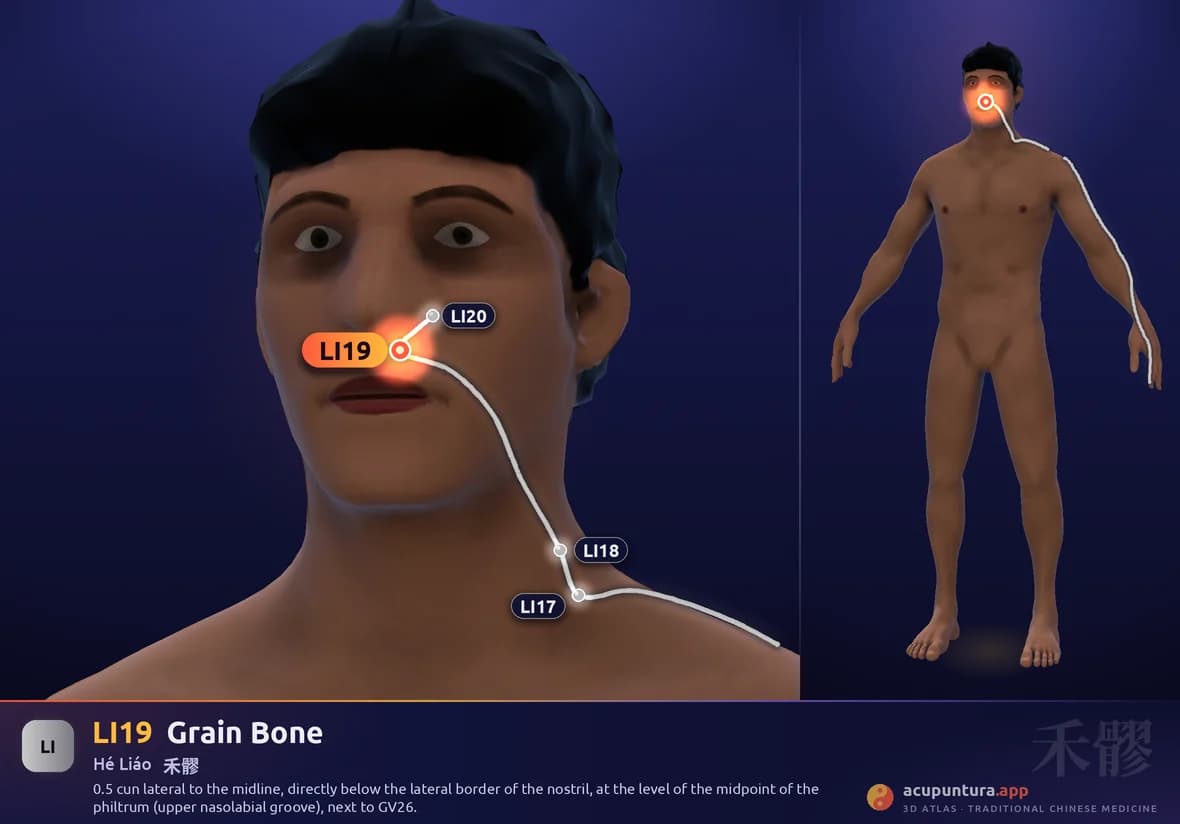
Large Intestine Channel
Grain Bone
禾髎Hé LiáoAnatomical location
0.5 cun lateral to the midline, directly below the lateral border of the nostril, at the level of the midpoint of the philtrum (upper nasolabial groove), next to GV26.
Main function
Opens the nasal passages, disperses Wind-Heat.
Therapeutic indications
- Rhinitis
- nasal congestion
- epistaxis
- facial pain
- Nasal obstruction
- Trismus
- Deviation of the mouth
- Loss of smell
- Rhinorrhea
- Facial paralysis
Name and classical tradition
Heliao, 禾髎, is the "grain cleft." 禾 is the cereal on the plant, the grain; 髎 is the hollow beside the bone. The point lies below the nose, on the edge of the maxilla, beside the mouth, and the explanation offered by the reference works is that this is where grain, food, enters. Another, more abstract reading takes 禾 as "something long and thin," from the shape of the character, and applies it to the cleft of the point. Neither has a classical commentator behind it.
In Chinese literature it is often called 口禾髎, "Heliao of the mouth," to distinguish it from TE22, the Heliao of the ear, on the Triple Energizer channel. The reference works also record a list of aliases, some with uncommon characters and probable transcription errors: 和窌, 頄, 長頻, 長髎, 長頰 and 長顪.
The Zhenjiu Jiayi Jing (Systematic Classic of Acupuncture and Moxibustion), the first work to record it, attributes to it nasal obstruction (鼻窒), deviation of the mouth (口僻), uncontrollable rhinorrhea and nosebleed, according to a paraphrase that has not been checked character by character.