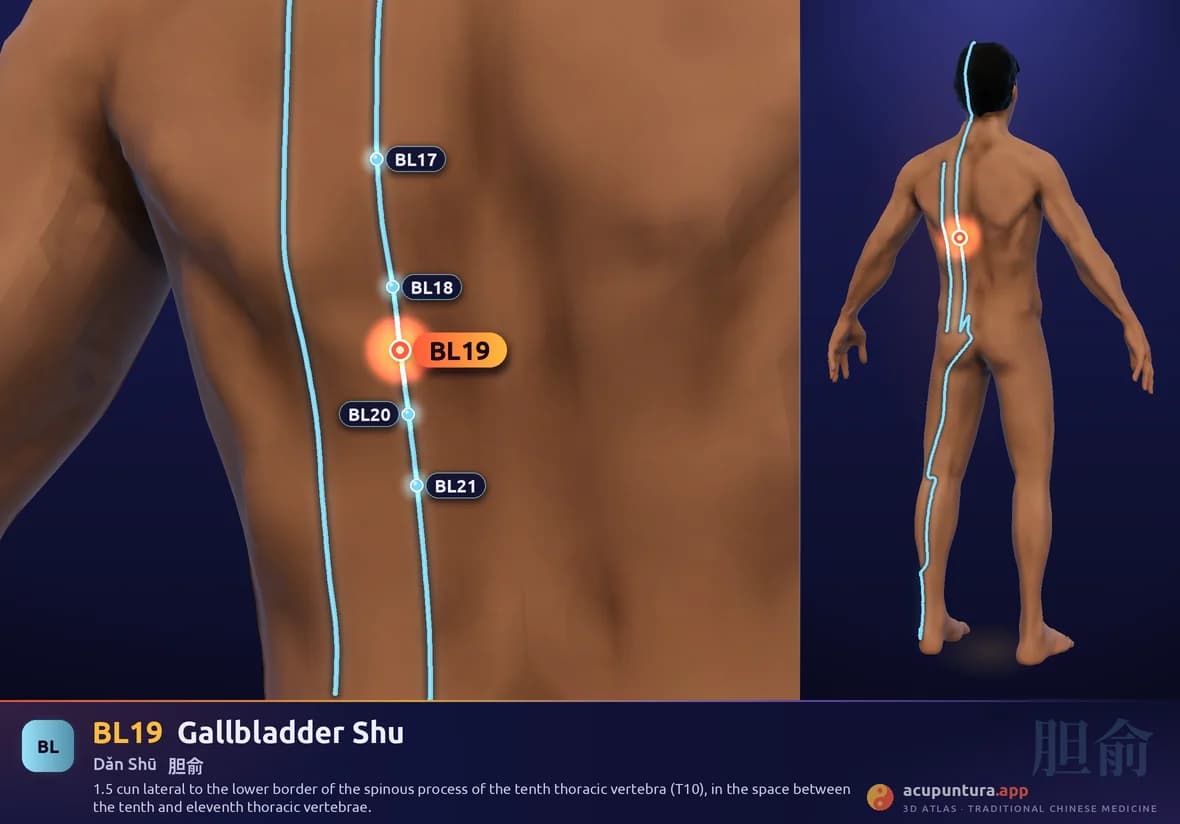
Bladder Channel
Gallbladder Shu
胆俞Dǎn ShūAnatomical location
1.5 cun lateral to the lower border of the spinous process of the tenth thoracic vertebra (T10), in the space between the tenth and eleventh thoracic vertebrae.
Main function
Regulates the Gallbladder, drains Damp-Heat, benefits the Liver and Gallbladder, relieves hypochondriac pain, treats jaundice, regulates the Stomach and Spleen.
- Back-Shu point of the Gallbladder
Therapeutic indications
- Hypochondriac pain
- back pain
- jaundice
- bitter vomit
- bitter taste in the mouth
- headache
- migraine
- dizziness
- fever
- chills
- hepatitis
- cholecystitis
- gallstones
- flank pain
- epigastric pain
- loss of appetite
- nausea
- vomiting
- stomach pain
- gastric ulcer
- shoulder pain
- stiff neck
- mid-back pain
- bitter mouth
- costal pain
- fatty liver
- gallstones and biliary colic
Name and classical tradition
Danshu, 胆俞, is the Back-Shu point of the Gallbladder. 胆 (膽) is the gallbladder; 俞 is the transport point. The Zhenjiu Jiayi Jing (Systematic Classic of Acupuncture and Moxibustion) places it «在第十椎下兩傍各一寸五分», one and a half cun to each side below the tenth vertebra, just below BL18, the Back-Shu point of the Liver, its paired organ.
It belongs to the core group of Back-Shu points of the Fu organs already recorded in the Jiayi Jing, unlike later Shu points such as BL16. The name 膽囊背俞穴, which sometimes appears, is a modern description and not an ancient name. No specific classical commentaries are known. Beside it, on the outer line, is BL48, Yanggang.