Bladder Channel
Governor Shu
督俞Dū ShūAnatomical location
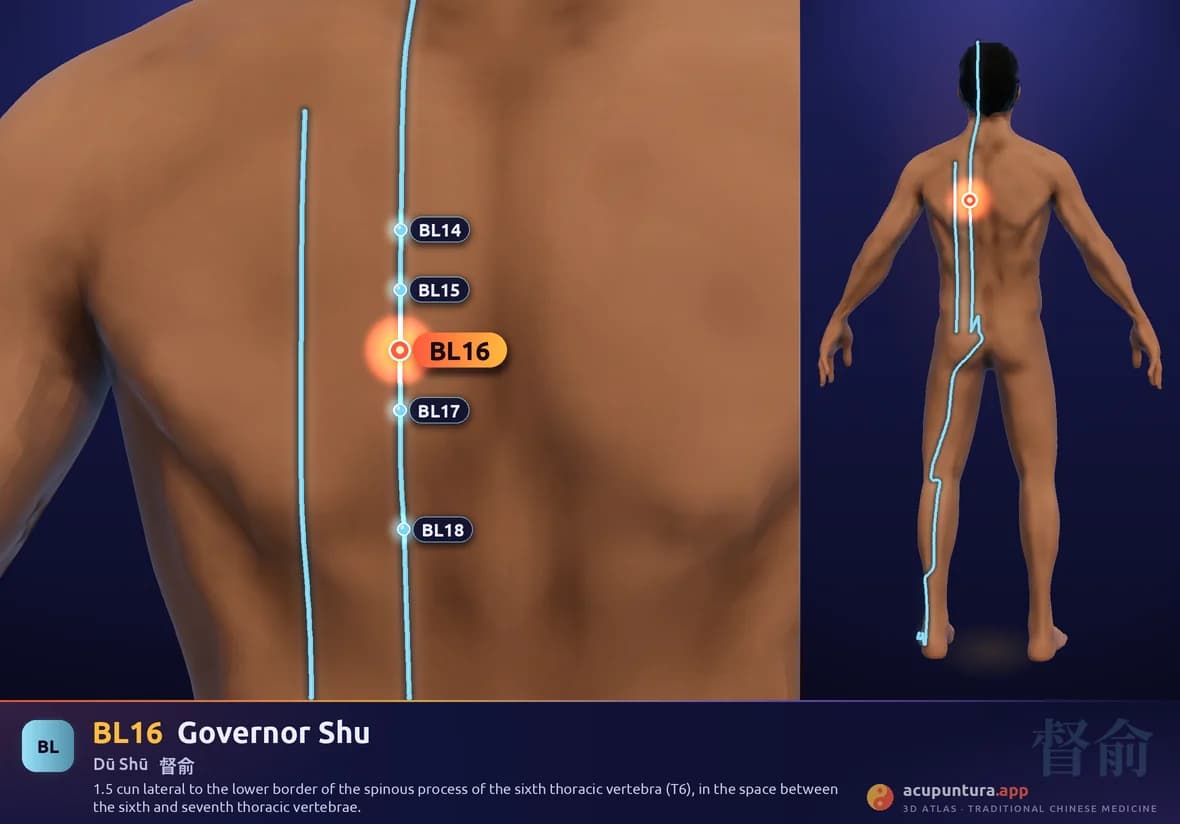
1.5 cun lateral to the lower border of the spinous process of the sixth thoracic vertebra (T6), in the space between the sixth and seventh thoracic vertebrae.
Main function
Regulates Liver Qi, relieves pain, harmonizes the Stomach, benefits the diaphragm, soothes back pain.
- Crossing point with the Du Mai
Therapeutic indications
- Chest pain
- hypochondriac pain
- stomach pain
- vomiting
- hiccups
- dysphagia
- back pain
- shoulder pain
- cough
- asthma
- fever without sweating
- jaundice
- hepatitis
- cholecystitis
- gastritis
- chest pain
- palpitations
- abdominal pain
- borborygmi
Name and classical tradition
Dushu, 督俞, is the transport point of the Du Mai, the Governing Vessel that runs along the spine. 督 is the Du, the one that governs; 俞, the transport point. It is a special case among the back Shu points, because it corresponds not to an organ or a Fu organ but to an Extraordinary Vessel. Ancient sources sometimes call it by its full name, 督脈俞.
Its historical interest is considerable. Dushu does not appear in the Zhenjiu Jiayi Jing (Systematic Classic of Acupuncture and Moxibustion), an absence that can be verified. Its formal incorporation into the Bladder channel came with Wang Zhizhong's Zhenjiu Zisheng Jing, in the Song period, in the 12th century, which drew on records of the Mingtang, a corpus of point locations lost as an independent work. The exact passage has not been checked. Together with BL14, BL24, and BL26, Dushu shows how the system of back Shu points was completed in layers, century after century.