Bladder Channel
Sea of Qi Shu
气海俞Qìhǎi ShūAnatomical location
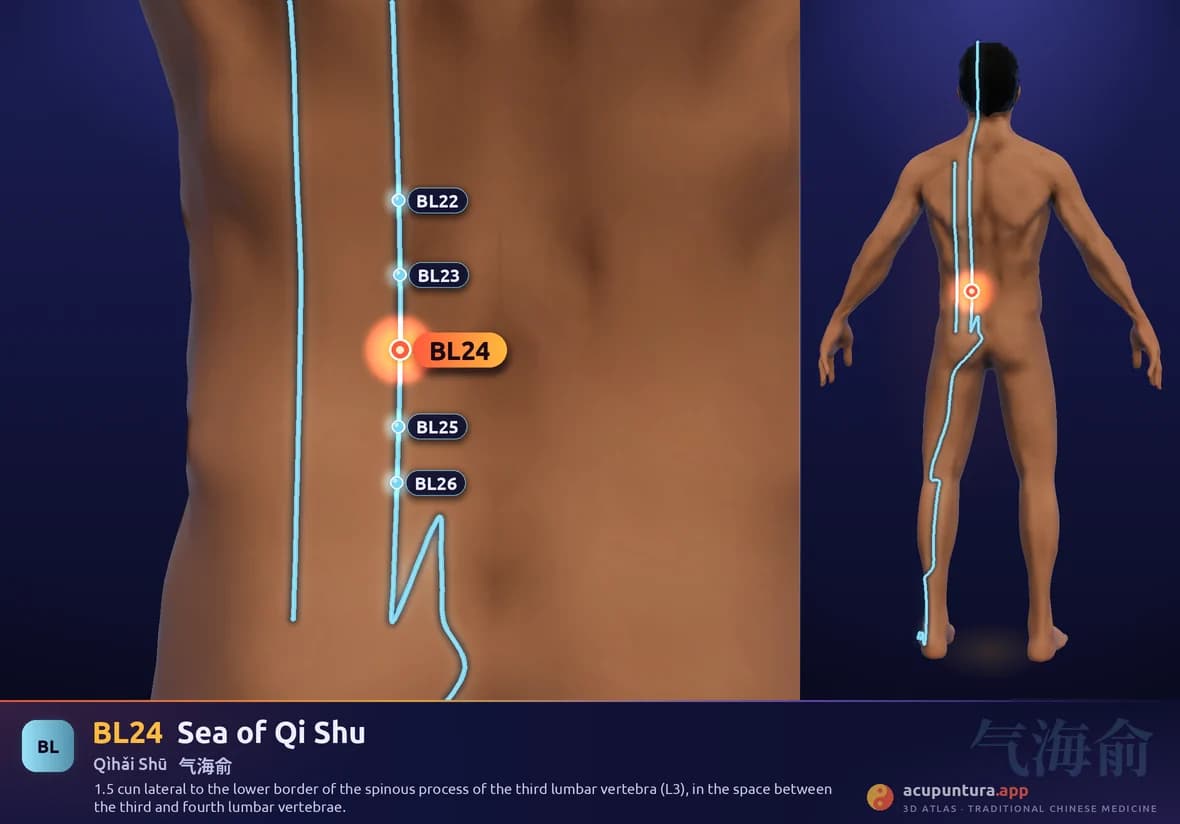
1.5 cun lateral to the lower border of the spinous process of the third lumbar vertebra (L3), in the space between the third and fourth lumbar vertebrae.
Main function
Strengthens the Kidney, benefits the lumbar region, regulates Qi, relieves pain, strengthens the back and knees, benefits the bladder, regulates urination, tonifies the Original Qi (Yuan Qi).
Therapeutic indications
- Low back pain
- weak knees
- pain in the lumbar spine
- sciatica
- dysuria
- enuresis
- urinary retention
- abdominal pain
- abdominal distension
- diarrhea
- dysmenorrhea
- leukorrhea
- hemorrhoids
- chronic fatigue
- general weakness
- impotence
- sterility
- leg pain
- hip pain
- Low back pain
- Leg weakness
Name and classical tradition
Qihaishu, 气海俞, is the transport point of the «sea of Qi». 气海 (氣海) refers to CV6, Qihai, the Ren Mai point below the navel, and the name expresses a relationship between front and back: Qihaishu lies on the back at the level that corresponds to Qihai on the abdomen. This is the logic of several later Shu points in the lumbar region, which are named not for an organ but for a point on the front.
The earliest ancient source found is the Taiping Shenghui Fang, from the Song dynasty, in the 10th century, which places it below the fifteenth vertebra, one and a half cun to each side. It does not appear in the Zhenjiu Jiayi Jing (Systematic Classic of Acupuncture and Moxibustion), at least as far as could be verified. Qihaishu thus reinforces the pattern of the lumbar and sacral Shu points added after the ancient core, such as BL26, BL16, or BL14.