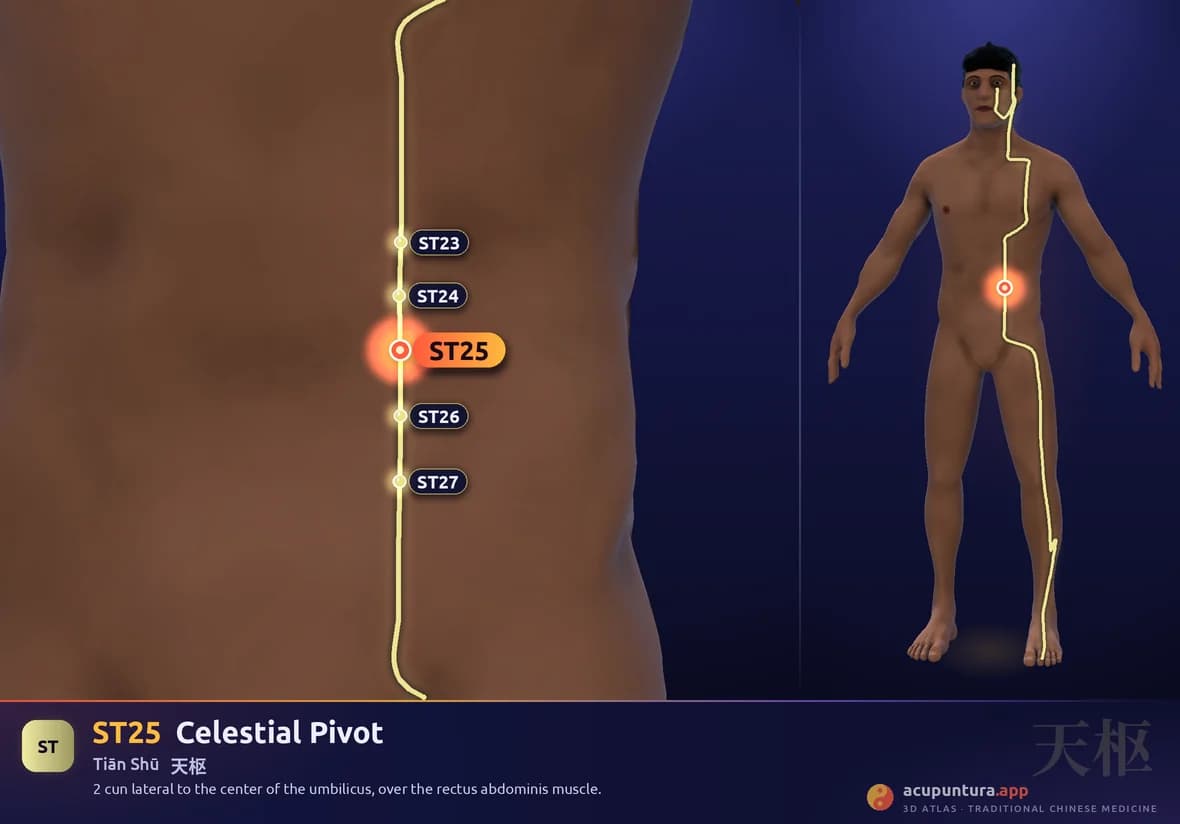
Stomach Channel
Celestial Pivot
天枢Tiān ShūUse caution during pregnancy
Mu point of the Large Intestine, on the abdominal flank. Shallow needling, and only during the early part of pregnancy.
Anatomical location
2 cun lateral to the center of the umbilicus, over the rectus abdominis muscle.
Main function
Regulates the Large Intestine, harmonizes the Stomach, transforms Dampness, relieves abdominal pain.
- Front-Mu point of the Large Intestine
- Crossing point with the Spleen
Therapeutic indications
- Abdominal pain
- diarrhea
- dysentery
- constipation
- menstrual disorders
- periumbilical pain
- abdominal distension
- borborygmi
- irregular menstruation
- dysmenorrhea
- edema
- indigestion
- obesity and overweight
- irritable bowel syndrome
- ulcerative colitis and Crohn's disease
Name and classical tradition
Tianshu (天枢) is the “celestial pivot” or “pivot of heaven,” and its name has one of the clearest foundations on the whole channel. The Suwen (Basic Questions), in the chapter Zhi Zhen Yao Da Lun (至真要大論), divides the body into two halves: the upper half is governed by the Qi of heaven, and the lower half by that of earth. It concludes: “身半以上⋯天氣主之;身半以下⋯地氣主之⋯半,所謂天樞也”. The midpoint of the body is what is called tianshu, the pivot between heaven and earth. The point, two cun from the umbilicus, lies on that dividing line.
天樞 is also the name of the first star of the Big Dipper (北斗). Some modern sources relate the point to the star, but no ancient citation establishes that link, so it is best taken as a comparison and not as an origin. For its location, the sources also refer to the Lingshu (Spiritual Pivot), chapter Gu Du (骨度), without a confirmed literal quotation.
Tianshu is the Front-Mu point (募穴) of the Large Intestine, the one that concentrates that organ's Qi in the abdomen. The standard references give it several alternative names of uneven antiquity: 長溪, the most consistent, 長谷, 谷門, and 補元. The 枢 of the name reappears on the flank, with GB27, Wushu.
The Qianjin Yaofang (Essential Prescriptions Worth a Thousand Gold), in chapter 15, recommends moxa with one hundred cones, “又灸天樞百壯,穴在挾臍相去三寸”, and adds right afterward an enigmatic warning: “魂魄之舍不可針”, the dwelling of the Hun and Po is not to be needled. The passage does not make entirely clear what it refers to, but this is how tradition understood it: the Zhenjiu Dacheng (Great Compendium of Acupuncture and Moxibustion) copies the phrase into the Tianshu entry, “千金云:魂魄之舍不可針”, and the pivot between the body's heaven and earth came to be regarded also as a dwelling of the soul.
Other names
- 長溪Jiayi Jing
- 谷門Jiayi Jing