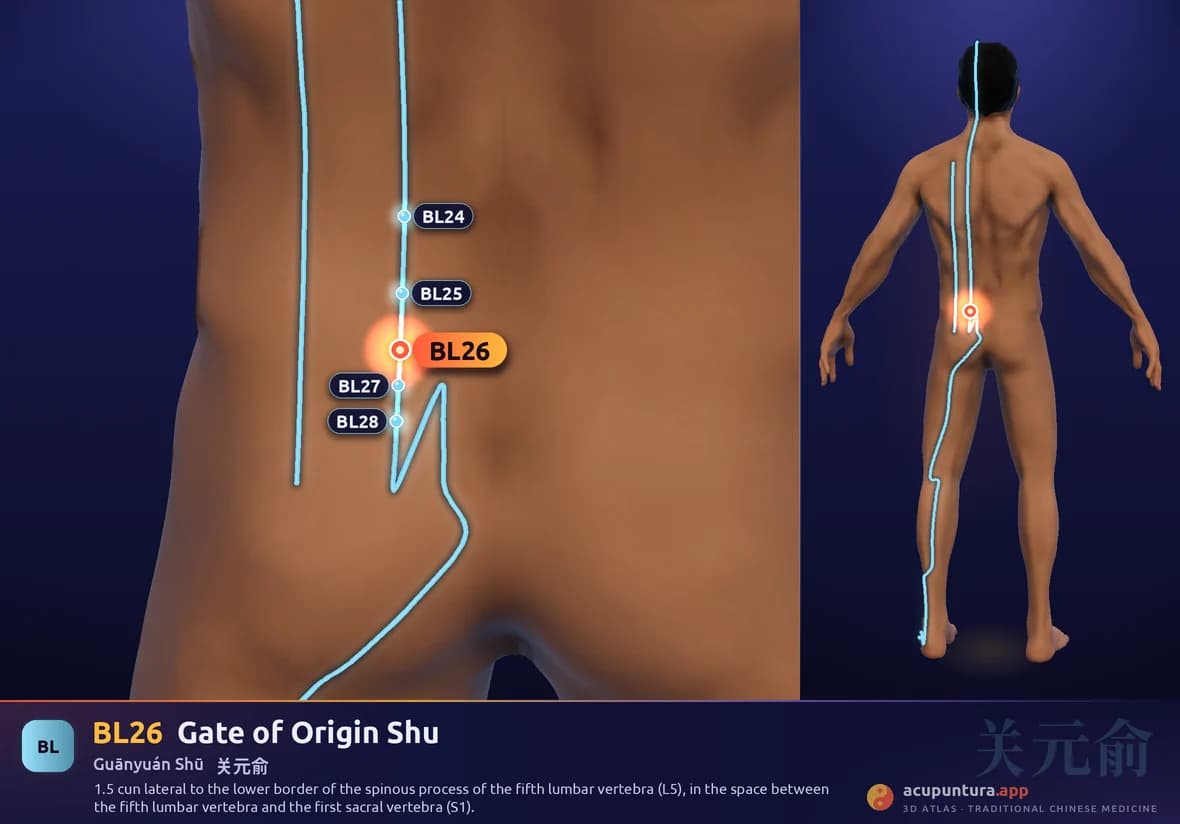
Bladder Channel
Gate of Origin Shu
关元俞Guānyuán ShūUse caution during pregnancy
Lumbosacral band; avoid strong stimulation.
Anatomical location
1.5 cun lateral to the lower border of the spinous process of the fifth lumbar vertebra (L5), in the space between the fifth lumbar vertebra and the first sacral vertebra (S1).
Main function
Strengthens the Kidney, benefits the lumbar region, regulates Qi and Blood, strengthens the muscles and tendons, benefits the bladder, regulates urination, tonifies the Original Qi (Yuan Qi).
Therapeutic indications
- Low back pain
- sciatica
- dysuria
- enuresis
- urinary retention
- abdominal pain
- abdominal distension
- diarrhea
- dysmenorrhea
- leukorrhea
- hemorrhoids
- chronic fatigue
- impotence
- sterility
- Low back pain
- Urinary frequency
- Lumbar disc herniation
- Ankylosing spondylitis
Name and classical tradition
Guanyuanshu, 关元俞, is the transport point of Guanyuan, the «barrier of the source», that is, of CV4, the Ren Mai point below the navel. Like BL24, its neighbor, it takes the name of a point on the front and not that of an organ, and the logic is the same: its position on the back corresponds to that of Guanyuan on the abdomen.
The earliest ancient source located is also the Taiping Shenghui Fang, from the Song dynasty, which places it below the seventeenth vertebra, one and a half cun to each side. Together with Qihaishu, it forms the group of «functional» lumbar Shu points added after the ancient core of the Back-Shu points of the Zang and Fu organs.