Bladder Channel
Bladder Huang
胞肓Bāo HuāngAnatomical location
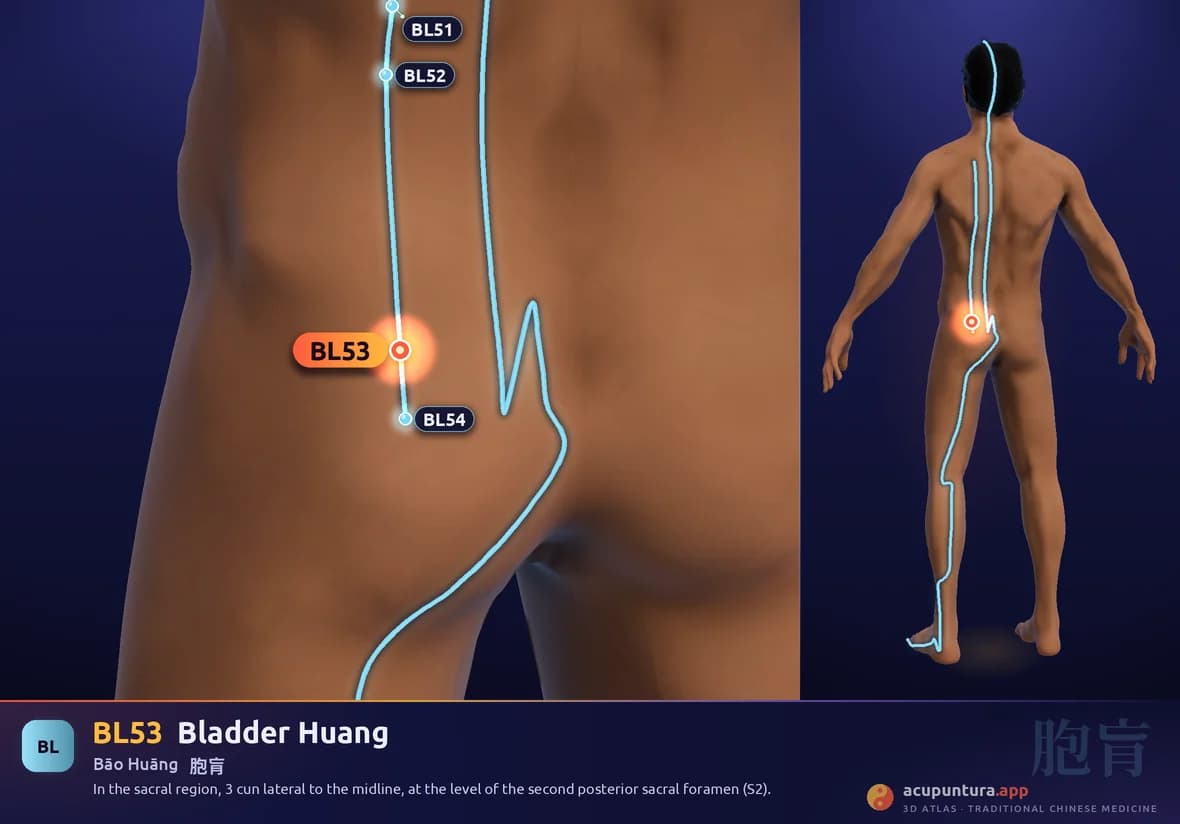
In the sacral region, 3 cun lateral to the midline, at the level of the second posterior sacral foramen (S2).
Main function
Regulates the Bladder, strengthens the lumbar and sacral region, resolves Dampness, regulates urination.
Therapeutic indications
- Low back pain
- sciatica
- dysuria
- urinary retention
- enuresis
- abdominal pain
- constipation
- Abdominal distension
- Borborygmi
- Lumbago
- Genital swelling
Name and classical tradition
Baohuang, 胞肓, combines 胞 and 肓, the membrane. The first character is ambiguous in classical medicine: 胞 can refer to the bladder, and also to the uterus, the “palace of the fetus.” The point lies on the outer line, at the level of BL28, the Back-Shu point of the Bladder, which favors the bladder reading, but the ambiguity of the character is real and none of the sources consulted resolves it for this point.
The Zhenjiu Jiayi Jing (Systematic Classic of Acupuncture and Moxibustion) locates it «在第十九椎下兩傍各三寸陷者中», three cun to each side below the nineteenth vertebra, in the depression. It shares the 肓 with BL43, Gaohuang, and BL51, Huangmen.