Bladder Channel
Upper Crevice
上髎ShàngliáoContraindicated during pregnancy
First sacral Liao; the four Liao act on the uterus and are used in childbirth.
Anatomical location
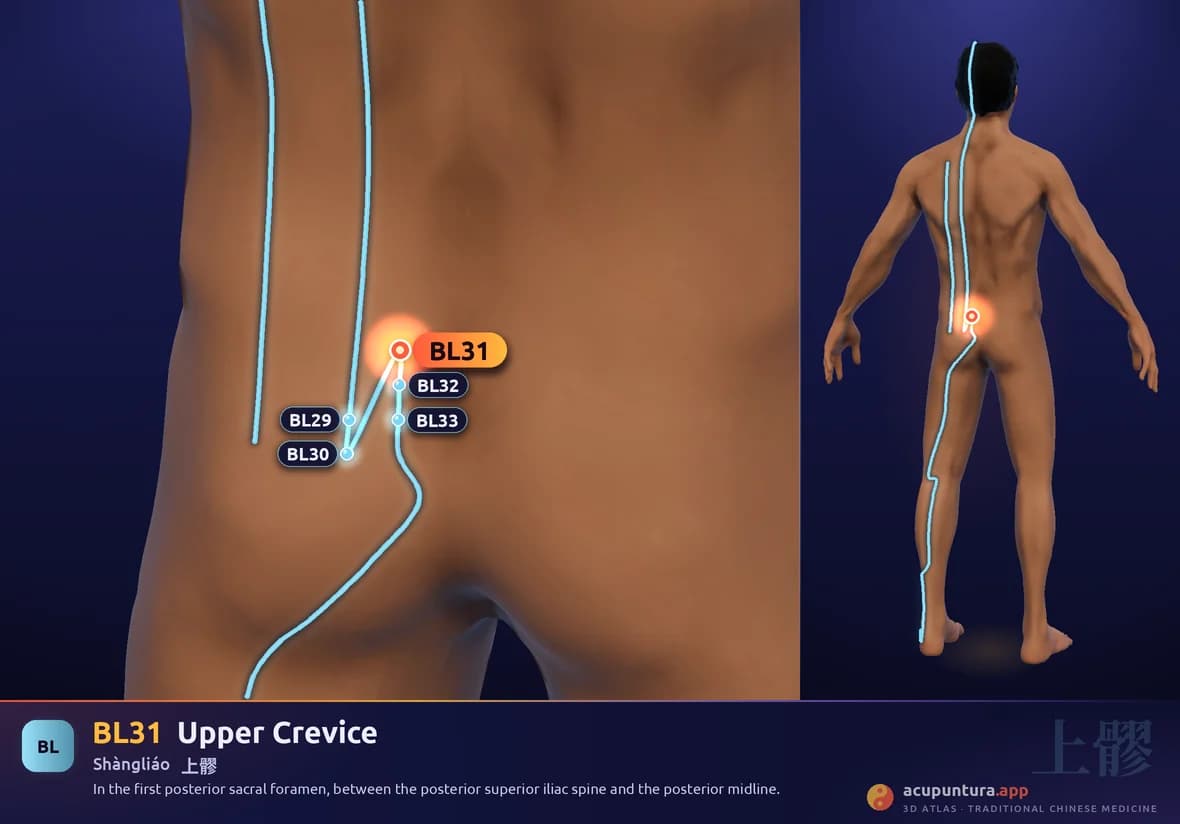
In the first posterior sacral foramen, between the posterior superior iliac spine and the posterior midline.
Main function
Regulates Qi and Blood, strengthens the Kidney, benefits the lumbar and sacral region, regulates urination, treats gynecological disorders, strengthens the pelvic region, regulates the Chong Mai and the Ren Mai.
- One of the Eight Liao (upper)
Therapeutic indications
- Low back pain
- sciatica
- dysuria
- enuresis
- urinary incontinence
- leukorrhea
- dysmenorrhea
- amenorrhea
- infertility
- impotence
- uterine prolapse
- hemorrhoids
- Irregular menstruation
- Infertility
- Urinary retention
- Sacral low back pain
- Constipation
Name and classical tradition
Shangliao, 上髎, is the “upper foramen.” 髎 is the hollow or cleft in the bone, and 上 indicates that it is the first, the highest, of a series of four: the points that occupy, on each side, the four posterior sacral foramina. Together with BL32, BL33, and BL34, it forms the group of the eight foramina (八髎穴), four per side, one of the most orderly naming sets on the channel: 上, 次, 中, and 下, upper, next, middle, and lower.
The Zhenjiu Jiayi Jing (Systematic Classic of Acupuncture and Moxibustion) locates it «在第一空,腰髁下一寸俠脊陷者中», in the first foramen, one cun below the hip bone, in the depression beside the spine. Secondary sources consider it a meeting point of the Bladder and Gallbladder channels, with no classical citation to confirm it. The group of the eight foramina has carried great weight in the gynecological and urinary tradition.