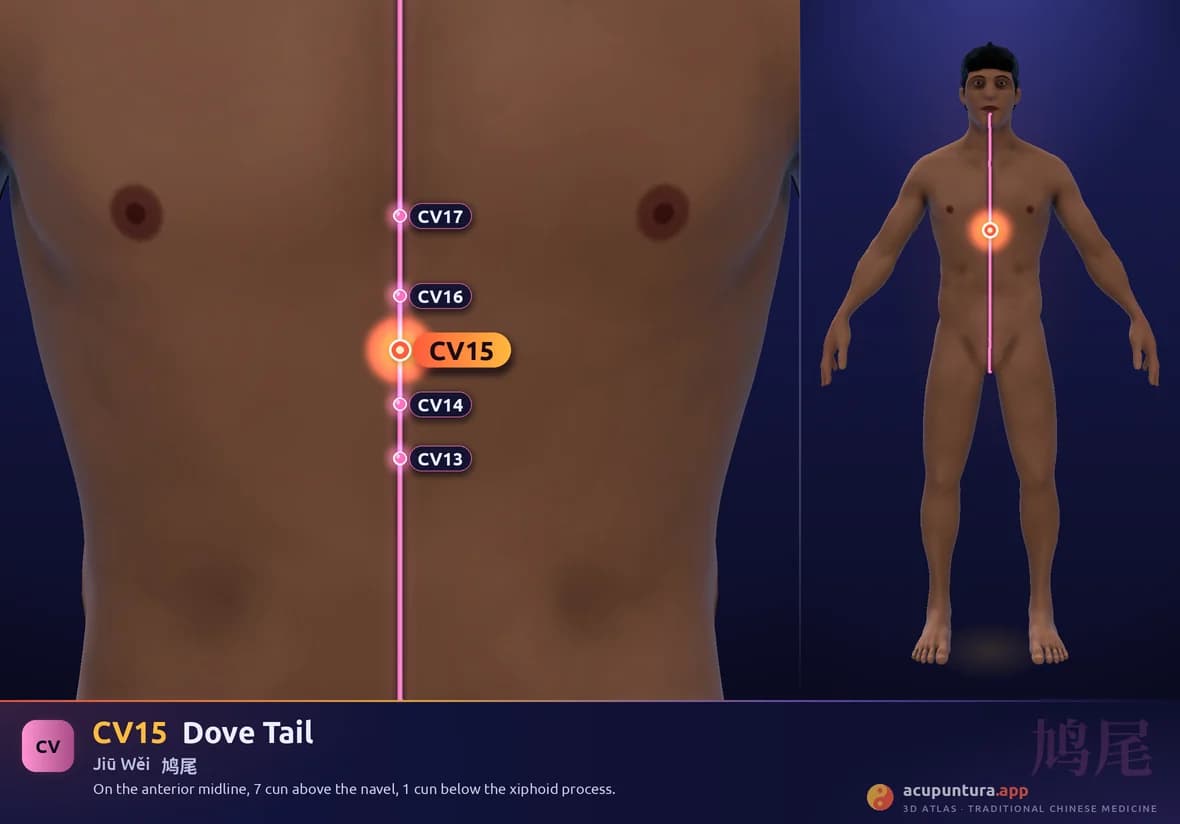
Ren Mai (Conception Vessel) Channel
Dove Tail
鸠尾Jiū WěiAnatomical location
On the anterior midline, 7 cun above the navel, 1 cun below the xiphoid process.
Main function
Calms the Shen, regulates the Qi of the chest.
- Great Luo of the Ren Mai
Therapeutic indications
- Chest pain
- anxiety
- epilepsy
- cough
- palpitations
- mania
- hiccups
- stomach pain
- panic attacks (Ben Tun Qi)
Name and classical tradition
Jiuwei, 鸠尾, is the "Turtledove's Tail." 鸠 (鳩) is the turtledove or pigeon; 尾 is the tail. The xiphoid process, at the lower end of the sternum, has the shape of that bird's tail, and the point lies just below it. It is a descriptive etymology, accepted without controversy.
The Lingshu (Spiritual Pivot) assigns it two roles. In the chapter Jiu Zhen Shi Er Yuan (九針十二原), it makes it a special Yuan-Source point: "膏之原,出於鳩尾," the Yuan-Source of the gao emerges at Jiuwei. Its counterpart, the Yuan-Source of the huang, is CV6, and the two terms together, gao and huang, give BL43, Gaohuang, its name. In the chapter Jing Mai, the collateral of the Ren Mai is called 尾翳 and descends from Jiuwei, so the point is also the Luo-Connecting point (絡穴) of the Ren Mai.
That name, 尾翳, "the shadow of the tail," is its best-documented alias, and it already appears in the Zhenjiu Jiayi Jing (Systematic Classic of Acupuncture and Moxibustion): "鳩尾,一名尾翳…在臆前,蔽骨下五分,任脈之別,不可灸刺." Jiuwei, also called Weiyi, lies in front of the chest, five fen below the sternum; it is the collateral of the Ren Mai; it is neither needled nor treated with moxibustion. The Zhenjiu Dacheng (Great Compendium of Acupuncture and Moxibustion) adds the alias 骭, an archaic form.
Other names
- 尾翳Jiayi Jing