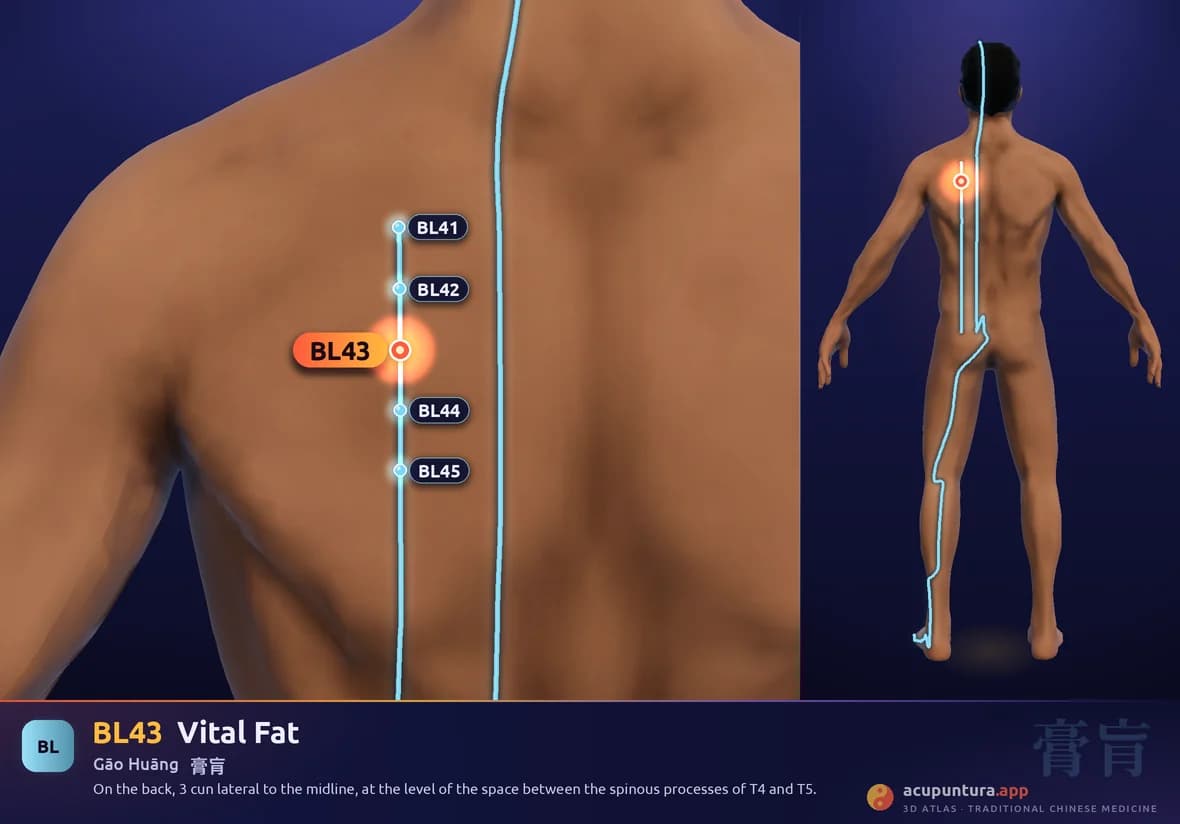
Bladder Channel
Vital Fat
膏肓Gāo HuāngAnatomical location
On the back, 3 cun lateral to the midline, at the level of the space between the spinous processes of T4 and T5.
Main function
Tonifies Qi and Blood, strengthens the Zang-Fu organs, benefits the Essence (Jing), relieves chest pain.
Therapeutic indications
- General weakness
- chronic fatigue
- cough
- asthma
- chest pain
- back pain
- chronic cough
- hemoptysis
- night sweats
- exhaustion
- memory impairment
- nocturnal emission
- indigestion
- convalescence
- post-traumatic stress
- fibromyalgia
- COPD and chronic bronchitis
- osteoporosis
Name and classical tradition
Gaohuang, 膏肓, is the most famous point name on the back, because the name predates the point by more than a millennium. 膏 means fat, the deepest part; 肓 means the membrane, the region of the diaphragm. The Zuozhuan (Zuo Commentary), the chronicle of the Spring and Autumn Annals, tells how Duke Jing of Jin fell ill and how the physician Huan (醫緩), summoned to treat him, declared the illness incurable because it had lodged between the gao and the huang, where neither needle nor medicine could reach. The story is more vivid in the original: before the physician arrived, the duke dreamed that his illness was two boys (二豎子), and that one said to the other, “居肓之上,膏之下,若我何”: if we stay above the huang and below the gao, what can they do to us? When the physician arrived, he gave the same diagnosis: “在肓之上,膏之下,攻之不可,達之不及,藥不至焉”, it lies above the huang and below the gao; it cannot be attacked, the needle cannot reach it, and medicines do not arrive. From this came the expression 病入膏肓, “the illness has entered the gao and the huang,” which in Chinese still means being beyond all remedy.
The acupuncture point came much later. Sun Simiao, in the seventh century, popularized it in the Qianjin Yaofang (Essential Formulas Worth a Thousand Gold) with unreserved praise, “膏肓穴,無所不治”, the Gaohuang point treats everything, and explicitly linked it to the story in the Zuozhuan: “昔秦緩不救晉侯之疾,以其在膏之上肓之下,針藥所不及,即此穴是也”, Physician Huan of Qin could not save the Marquis of Jin because the illness lay between the gao and the huang, where neither needle nor medicine reaches; that place is this point. Curiously, Sun Simiao reverses the order given in the chronicle. He recommended it for wasting and exhaustion, with moxa in astonishing quantities: “至六百壯,多至千壯”, up to six hundred cones, and even a thousand. In the Song period, Zhuang Chuo devoted an entire monograph to it, the Zhi Gaohuang Shuxue Fa. It is worth separating the two facts: the Zuozhuan does not speak of a point but of a region of the body, and it was the later medical tradition that took the expression to name it.
Its full name is 膏肓俞. The Tongren Shuxue Zhenjiu Tujing (Illustrated Manual of Acupuncture Points on the Bronze Figure), from the Song period, confirmed its place on the Bladder channel, level with the fourth vertebra, on the outer line, next to BL14.