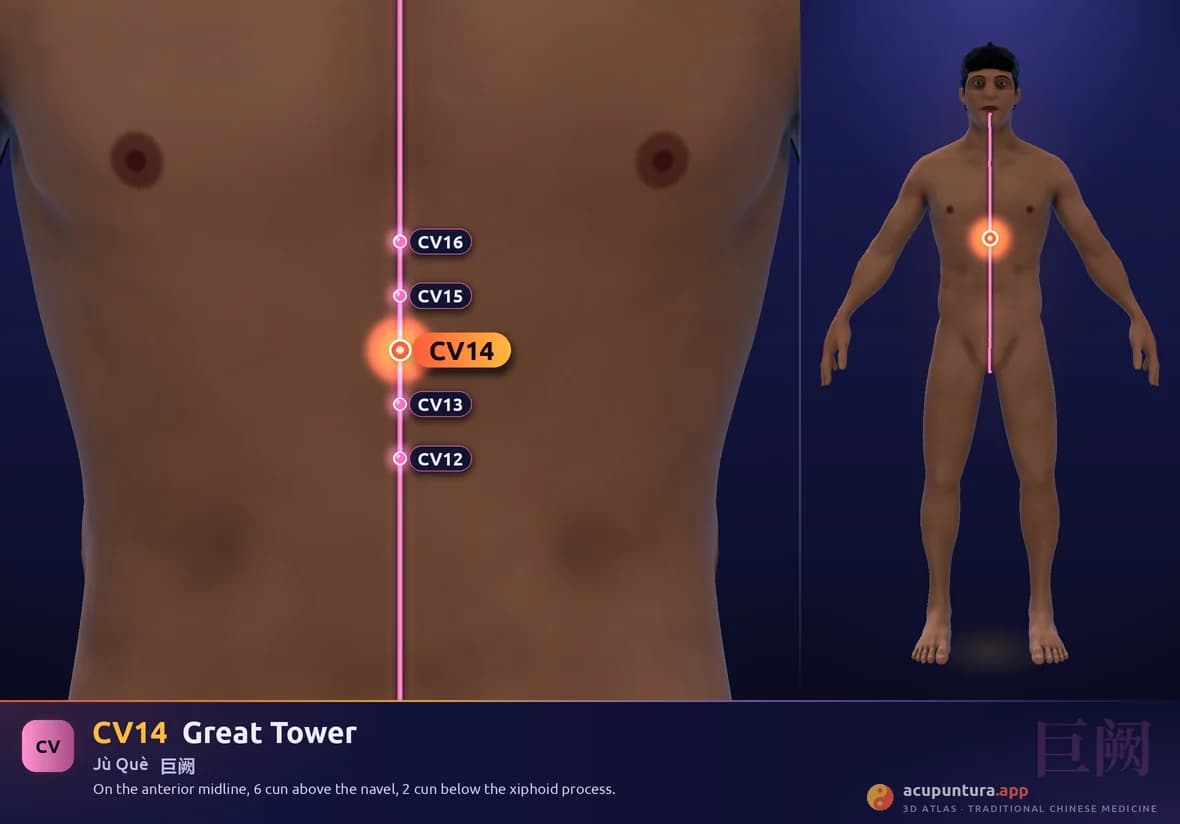
Ren Mai (Conception Vessel) Channel
Great Tower
巨阙Jù QuèAnatomical location
On the anterior midline, 6 cun above the navel, 2 cun below the xiphoid process.
Main function
Calms the Shen, regulates the Qi of the chest.
- Front-Mu point of the Heart
Therapeutic indications
- Chest pain
- palpitations
- anxiety
- epilepsy
- insomnia
- mania
- vomiting
- heartburn
- hiccups
- stomach pain
- panic attacks (Ben Tun Qi)
Name and classical tradition
Juque, 巨阙, is the "Great Gate Tower." 巨 means great; 阙 (闕) is the tower that flanked the entrance of a palace, the same character as in CV8, Shenque. The point lies below the xiphoid process, very close to the heart, and one of the readings is courtly: the heart is the sovereign of the body, and the point would be the great gate of its dwelling. Another gloss, a modern one, speaks of the great amount of vapor that gathers here. Neither has an ancient commentary behind it.
Juque is the Front-Mu point (募穴) of the Heart. Its textual origin is disputed: one source places it in the Shanghan Lun (Treatise on Cold Damage), in the Ping Mai Fa section, although there it may refer to a diagnostic region rather than the point; another places it in the Maijing (Pulse Classic). The reference works record the variants 巨缺 and 巨送. With it begins the series of palatial names on the chest of the Ren Mai, which continues with CV16, CV18, CV19, CV20, and CV21.