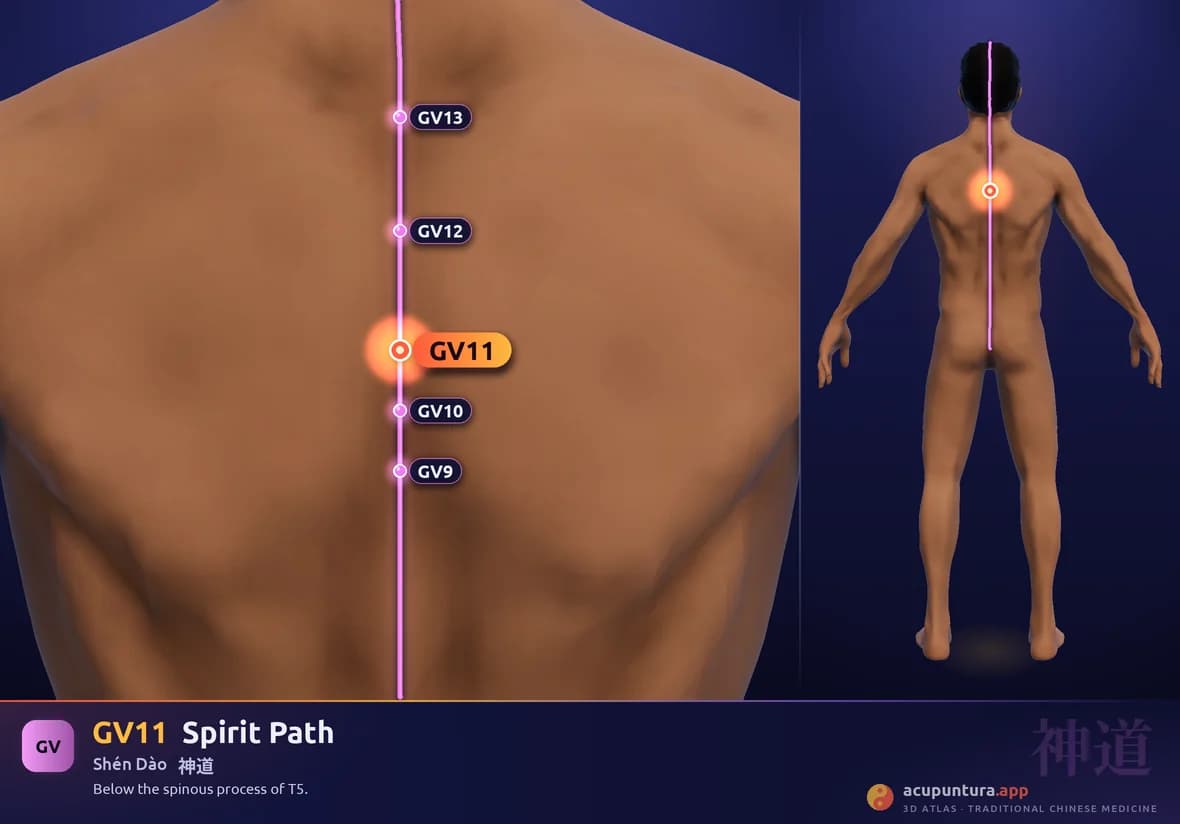
Du Mai (Governing Vessel) Channel
Spirit Path
神道Shén DàoAnatomical location
Below the spinous process of T5.
Main function
Calms the Shen, regulates the Heart, strengthens the spine.
Therapeutic indications
- Palpitations
- insomnia
- back pain
- anxiety
- Memory impairment
- Stiffness of the back
- Cough
- Fever
Name and classical tradition
Shendao, 神道, is the “path of the spirit.” 神 is the shen, the spirit that Chinese medicine places in the Heart (心藏神); 道 is the path, the way. The point lies below the fifth thoracic vertebra, at the same level as BL15, Xinshu, the Heart Shu point, and the name presents it as the pathway of Heart Qi. The indications the sources give for it follow that line: confusion, sadness, oppression of Heart Qi.
The correspondence of levels with Xinshu is a consistent detail. The sources trace the point to the Zhenjiu Jiayi Jing (Systematic Classic of Acupuncture and Moxibustion), with no confirmed verbatim quotation. The reference works record the alternative name 衝道. The 神 in the name is the same as in BL44, Shentang, also at the level of the fifth vertebra, on the outer line of the Bladder.