Bladder Channel
Heart Shu
心俞Xīn ShūAnatomical location
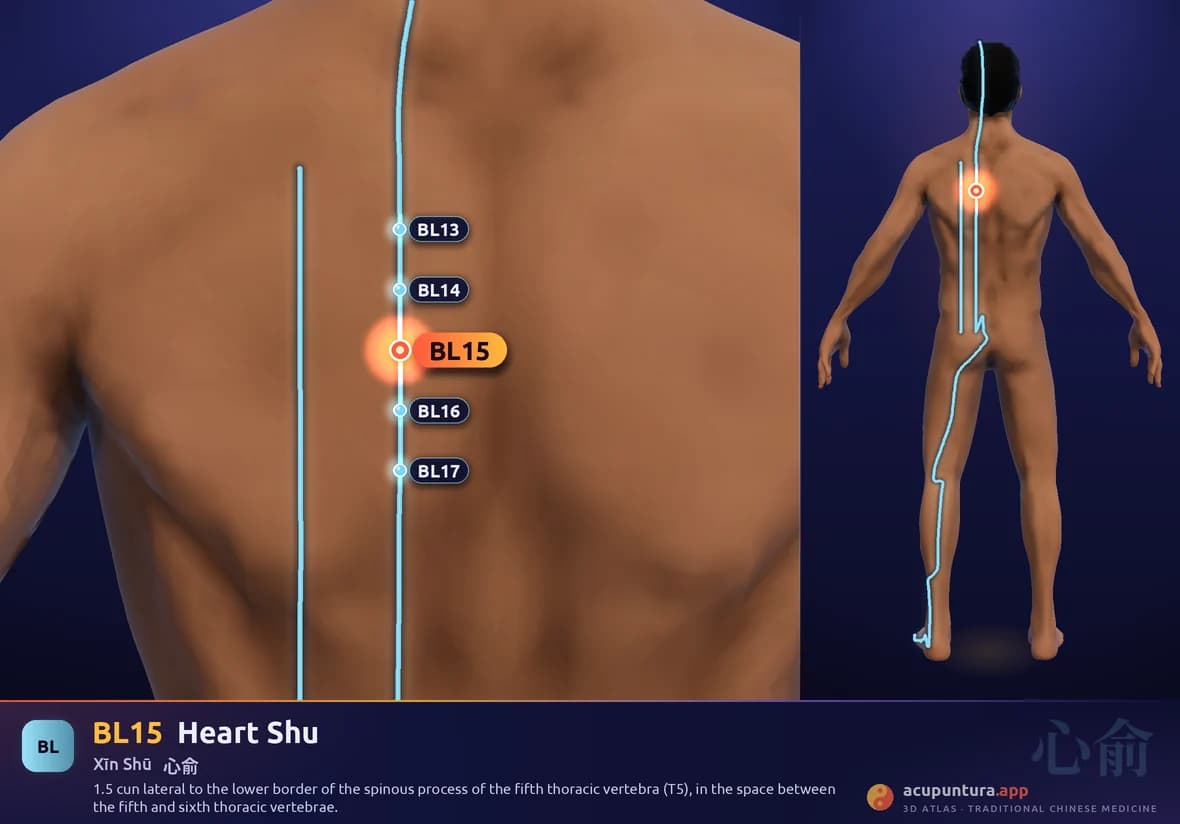
1.5 cun lateral to the lower border of the spinous process of the fifth thoracic vertebra (T5), in the space between the fifth and sixth thoracic vertebrae.
Main function
Regulates the Heart, calms the Shen (Spirit), nourishes Heart Blood, promotes the circulation of Qi and Blood, relieves chest tightness.
- Back-Shu point of the Heart
Therapeutic indications
- Palpitations
- chest pain
- angina pectoris
- chest tightness
- insomnia
- excessive sleep
- poor memory
- anxiety
- depression
- mania
- hysteria
- epilepsy
- hemoptysis
- night sweats
- fever of unknown origin
- back pain
- memory impairment
- chest pain
- schizophrenia (Dian Kuang)
- bipolar disorder (alternating Dian-Kuang)
- panic attacks (Ben Tun Qi)
- post-traumatic stress
- cognitive decline and dementia
- fibromyalgia
- low blood pressure
Name and classical tradition
Xinshu, 心俞, is the back transport point of the Heart: 心, the heart, and 俞, the place where the Qi of the organ pours toward the back. The Lingshu (Spiritual Pivot), in the chapter Bei Shu (背腧), places it in its list of the Shu points of the organs: “心腧在五焦之間”, the Shu of the Heart is in the space of the fifth vertebra.
It is one of the points of the oldest core of the system, along with BL13, BL18, BL20, and BL23, the Shu points of the organs that the Bei Shu lists. Later sources place it between the fifth and sixth thoracic vertebrae depending on the method of measurement, a small variation that recurs in the history of these points. Next to it, on the outer line, BL44, Shentang, the “hall of the spirit,” captures the spiritual aspect of the Heart.