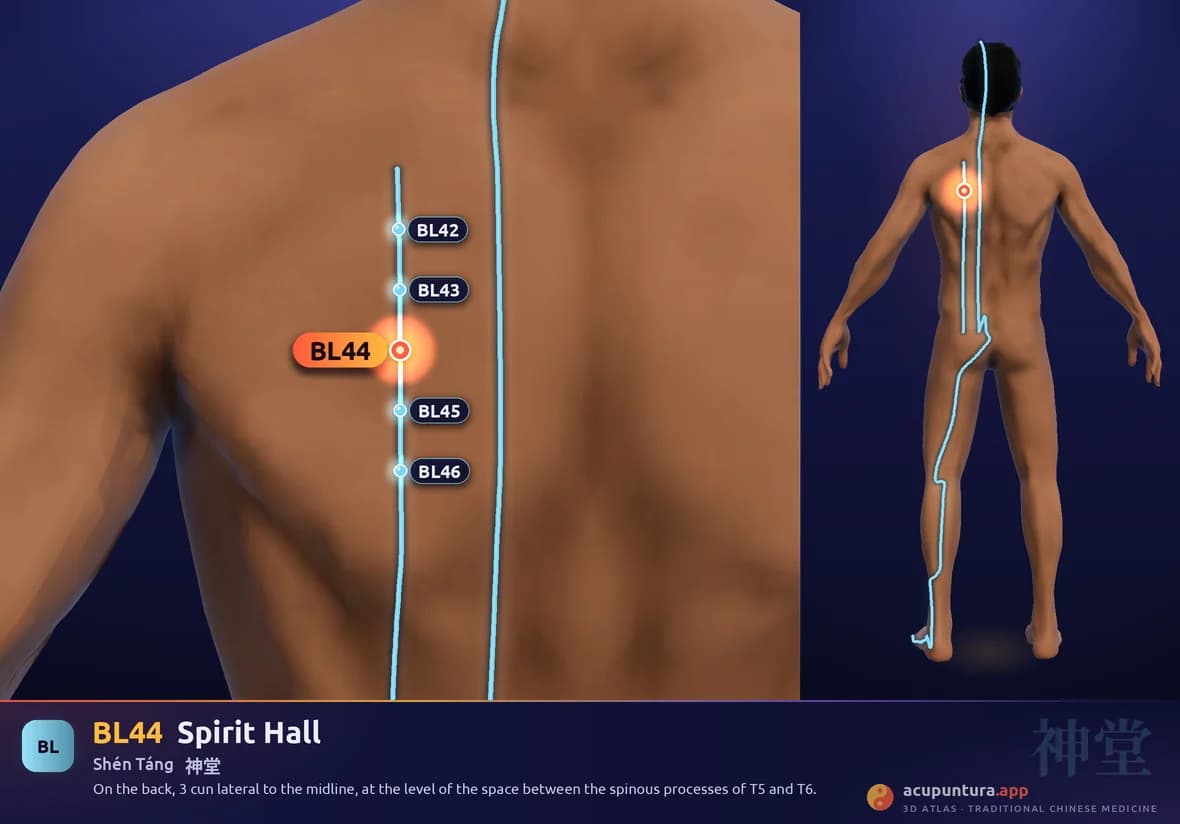
Bladder Channel
Spirit Hall
神堂Shén TángAnatomical location
On the back, 3 cun lateral to the midline, at the level of the space between the spinous processes of T5 and T6.
Main function
Regulates the Heart, calms the Shen (Spirit), relieves chest oppression, strengthens the back, benefits the nervous system.
- Point of the Shen (spirit)
Therapeutic indications
- Chest pain
- palpitations
- insomnia
- anxiety
- depression
- back pain
- neck stiffness
- cough
- asthma
- sensation of oppression in the chest
- back stiffness
- schizophrenia (Dian Kuang)
- bipolar disorder (alternating Dian-Kuang)
- panic attacks (Ben Tun Qi)
- post-traumatic stress
Name and classical tradition
Shentang, 神堂, is the “hall of the spirit.” 神, the Shen, is the spirit that Chinese medicine places in the Heart; 堂 is the hall, the main room of the house. The point sits on the outer line of the back, next to BL15, the Back-Shu point of the Heart, and the reference works explain it directly: the Heart stores the Shen, and the point beside it carries its name.
It is the second piece of the series of soul points on the second line of the back, after BL42, Pohu, the door of the Po of the Lung, and before BL47, Hunmen. The Zhenjiu Jiayi Jing (Systematic Classic of Acupuncture and Moxibustion) locates it three cun to each side below the fifth vertebra, in a depression. It shares the character 神 with other points devoted to the spirit, such as HT7, Shenmen, at the wrist, or GV24, Shenting, on the forehead.