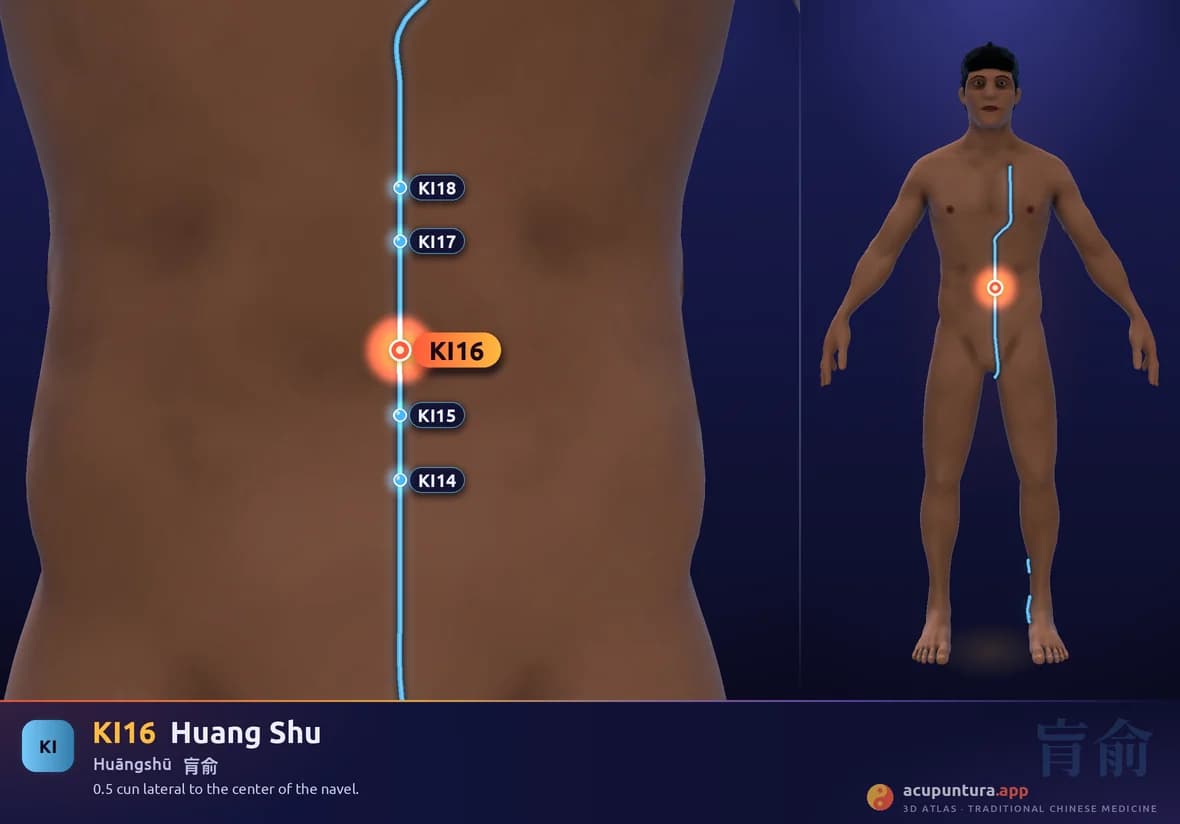
Kidney Channel
Huang Shu
肓俞HuāngshūUse caution during pregnancy
Next to the navel; shallow needling or abstention.
Anatomical location
0.5 cun lateral to the center of the navel.
Main function
Regulates Kidney Qi, strengthens the Spleen and Stomach, harmonizes the Middle Jiao, and treats digestive disorders.
- Crossing point with the Chong Mai
Therapeutic indications
- Abdominal pain
- diarrhea
- dyspepsia
- nausea
- enuresis
- low back pain
- periumbilical pain
- constipation
- abdominal distension
- hernia
- menstrual irregularity
Name and classical tradition
Huangshu, 肓俞, is the "transport point of the membrane." 肓 is a term from classical medicine for the membrane, the deep region near the diaphragm, the same character as in the expression 病入膏肓, which gives BL43, Gaohuang, its name; 俞 is the transport point. The modern gloss interprets it as the place where a fatty substance rises toward the surface, with no classical citation.
The point lies beside the navel and is a crossing point of the Chong Mai and the Kidney channel. Its origin is placed in the Zhenjiu Jiayi Jing (Systematic Classic of Acupuncture and Moxibustion), although the sentence has not survived. The reference works record the variant 盲俞, with 盲, "blind," in place of 肓, two very similar characters that may be a historical variant or a copying error.