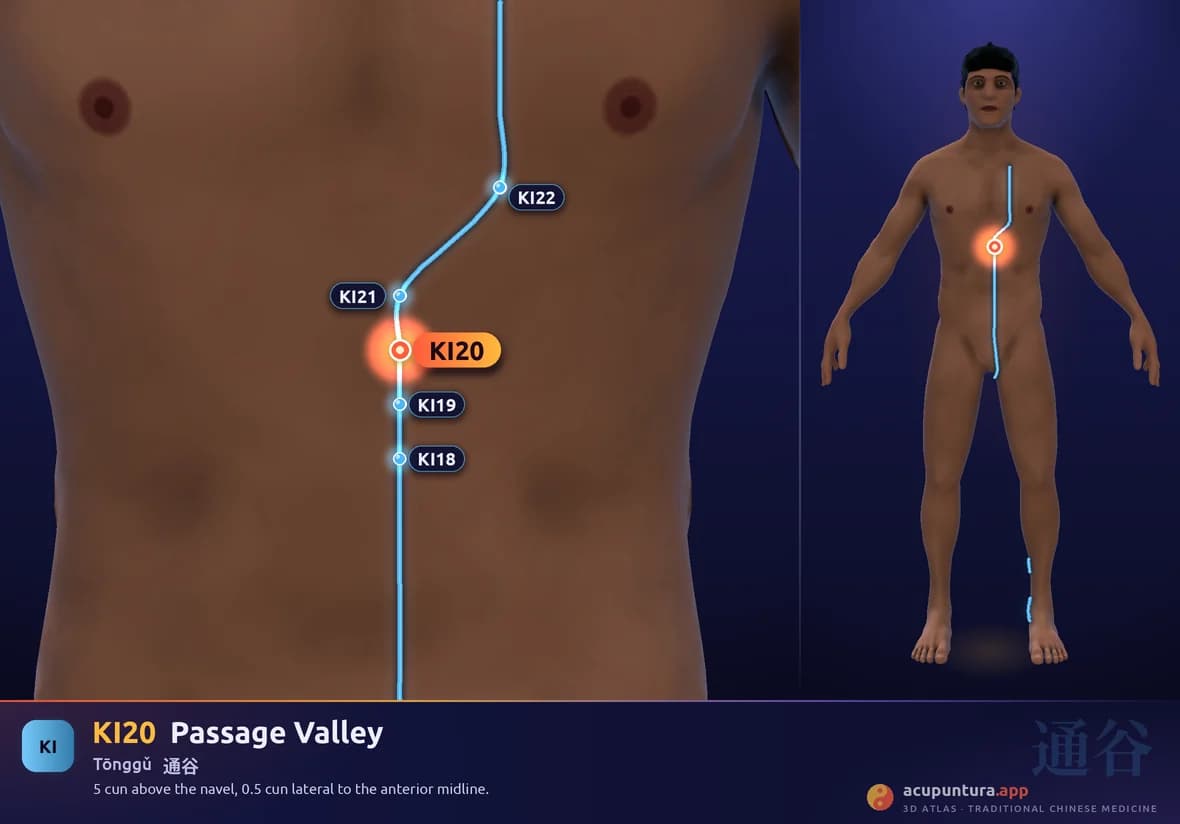
Kidney Channel
Passage Valley
通谷TōnggǔAnatomical location
5 cun above the navel, 0.5 cun lateral to the anterior midline.
Main function
Regulates Kidney Qi, benefits the chest and hypochondrium, and treats thoracic and emotional disorders.
- Crossing point with the Liver
Therapeutic indications
- Cough
- asthma
- chest pain
- anxiety
- nausea
- hypochondriac pain
- abdominal distension
- vomiting
- indigestion
- palpitations
Name and classical tradition
Tonggu, 通谷, is the "passage valley." 通 means to pass through, to cross, to communicate; 谷 is the valley. To distinguish it from its namesake on the foot, BL66, Zutonggu, of the Bladder, it is also called 腹通谷, "abdominal Tonggu." They are two different points that share a name, and the prefix added to each resolves the ambiguity.
The modern gloss speaks of the Kidney and Chong Mai Qi cooling here and descending into the deep tissues, with no classical citation. The sources trace it to the Zhenjiu Jiayi Jing (Systematic Classic of Acupuncture and Moxibustion) and mention a variant of the name in the Zhenjiu Daquan. The reference works record the form 通骨, with "bone" in place of "valley." It is a crossing point of the Chong Mai and the Kidney channel, and its location varies among the sources, at four or five cun above the navel, and it has not been identified which work gives which measurement.