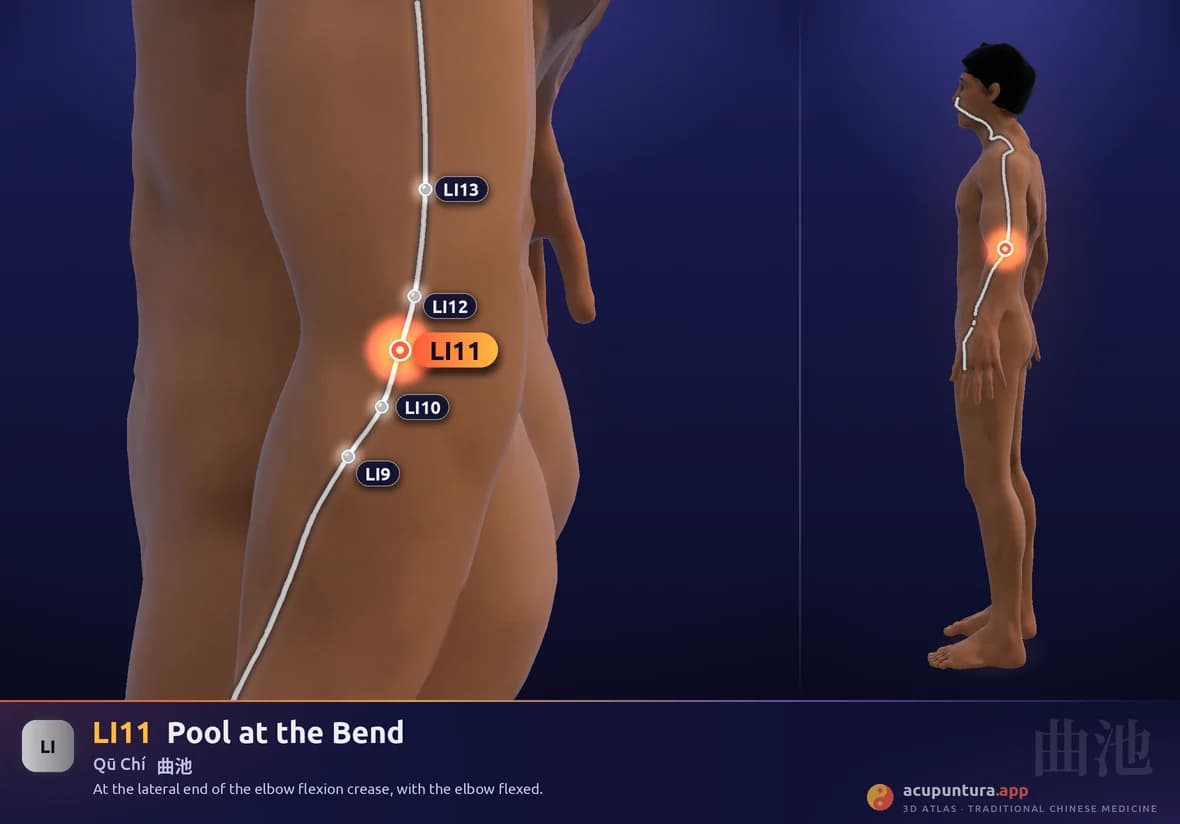
Large Intestine Channel
Pool at the Bend
曲池Qū ChíAnatomical location
At the lateral end of the elbow flexion crease, with the elbow flexed.
Main function
Clears Heat, regulates Qi and Blood, benefits the skin.
- He-Sea point (Earth)
- Tonification Point
Therapeutic indications
- Fever
- hives
- elbow pain
- hypertension
- eczema
- pruritus
- boils
- skin allergies
- epicondylitis
- limited elbow motion
- hemiplegia
- sore throat
- toothache
- red eyes
- dysentery
- abdominal pain
- amenorrhea
- Heat in the Blood
- schizophrenia (Dian Kuang)
- acute psychosis
- Parkinson's disease (tremor due to Internal Wind)
- multiple sclerosis (Wei syndrome)
- hyperuricemia and gout
- rheumatoid arthritis
- psoriasis
- atopic dermatitis
- alopecia areata
- acne
- herpes zoster and postherpetic neuralgia
Ryodoraku
- Tonification of Large Intestine
Name and classical tradition
Quchi, 曲池, is the “pool at the bend.” 曲 is to bend, to curve; 池, a pond, the pool that forms in a hollow. The name combines an instruction and an image: you have to bend the elbow to find the point, and then the pit appears where the qi pools. The Lingshu (Spiritual Pivot), in the chapter Ben Shu (本輸), says it almost in those words: “入於曲池,在肘外輔骨陷者中,屈臂而得之,為合.” The qi enters Quchi, in the depression on the outer side of the elbow, beside the bone; it is found by bending the arm; it is the He-Sea point. On the yang channels, the He-Sea point (合穴) corresponds to Earth.
One of its alternative names underscores a notable parallel: 陽澤, the “yang marsh.” In the same elbow crease, on the yin side, the paired Lung channel has its own He-Sea point, LU5, Chize, the “elbow marsh.” Two paired channels, two He-Sea points at the same flexure, two names for standing water, one yin and one yang.
The other aliases point to a different tradition. 鬼臣, “minister of the spirits,” is the name under which Quchi appears among the thirteen spirit points (十三鬼穴) in Sun Simiao's Qianjin Yaofang (Essential Formulas Worth a Thousand Gold), used for mental disorders and madness. 鬼腿 is also listed. The Qianjin says so explicitly: the twelfth point is “尺澤橫紋外頭接白肉際,名鬼臣…即曲池穴也,” at the outer end of the elbow crease, called “minister of the spirits,” and the note identifies it with Quchi.
Other names
- 鬼臣Qianjin Yaofang