Large Intestine Channel
Arm Five Li
手五里Shǒu Wǔ LǐAnatomical location
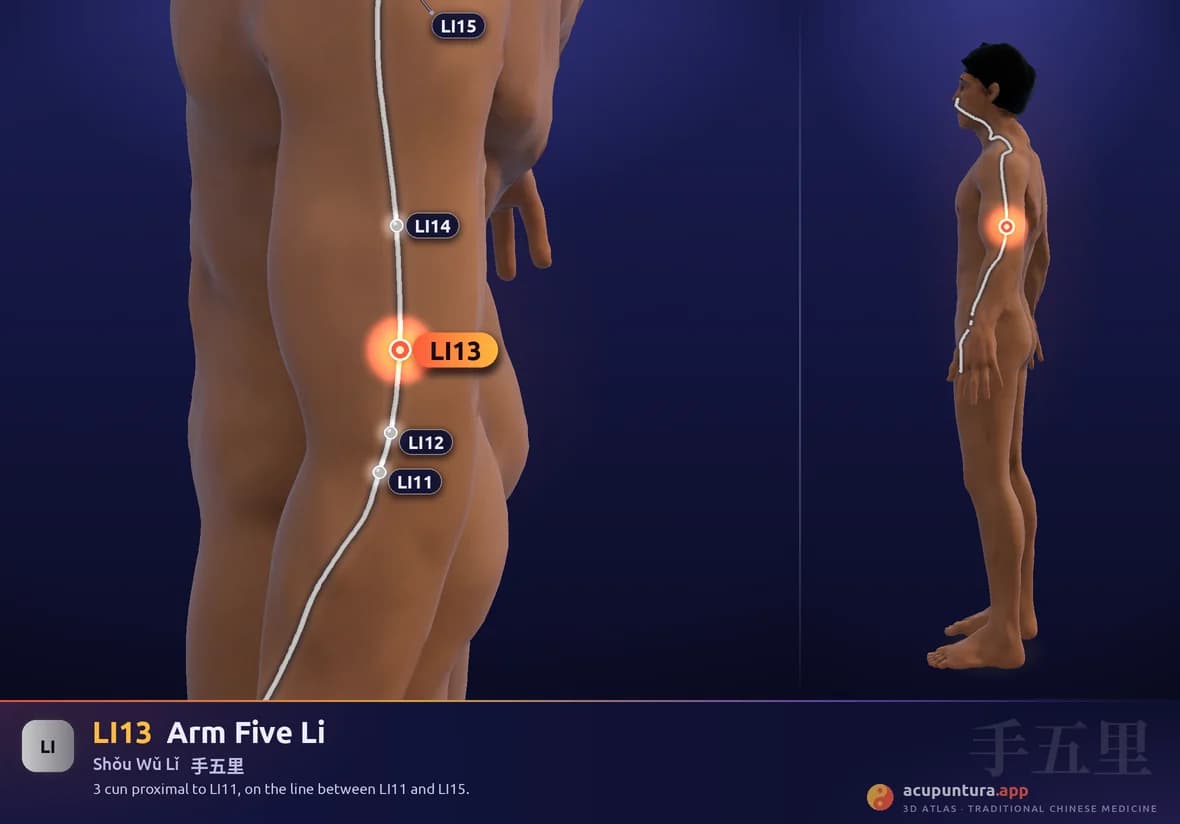
3 cun proximal to LI11, on the line between LI11 and LI15.
Main function
Disperses Wind-Dampness, relieves arm pain.
Therapeutic indications
- Arm pain
- stiff neck
- headache
- scrofula
- cough
- drowsiness
- arm pain and contracture
- pneumonia
Name and classical tradition
Shouwuli, 手五里, is the "Wuli of the hand," and it has one of the most singular histories on the channel: it is one of the few points that the Lingshu (Spiritual Pivot) expressly names as a place where needling is forbidden. In the Ben Shu chapter (本輸), without listing it among the five transport points, the text says: «陰尺動脈,在五里,五腧之禁也». The artery of the forearm is at Wuli; it is the prohibition of the five points. The quotation comes from a secondary source and has not been checked character by character, but the prohibition is a solid classical fact that was upheld and commented on throughout the later tradition. Hence its most eloquent alternative name: 大禁, "the great prohibition."
In the Lingshu the point was called simply 五里. In the Song dynasty, the Shengji Zonglu (Comprehensive Recording of Sagely Benefit) called it 臂五里, "Wuli of the arm," and Wang Zhizhong's Zhenjiu Zisheng Jing (Classic of Nourishing Life with Acupuncture and Moxibustion) called it 手五里, to distinguish it from the Wuli of the leg, LR10, on the Liver channel. The reference works also record the forms 尺之五里 and 手之五里.
The 里 in the name, according to a gloss attributed to Yang Shangshan in the 7th century, would here be equivalent to 寸, the cun, so that 五里 would mean "five cun" from a reference point. The attribution comes from a modern academic study and has not been verified in the Taisu, but it fits the metric tone of the Ben Shu passage.