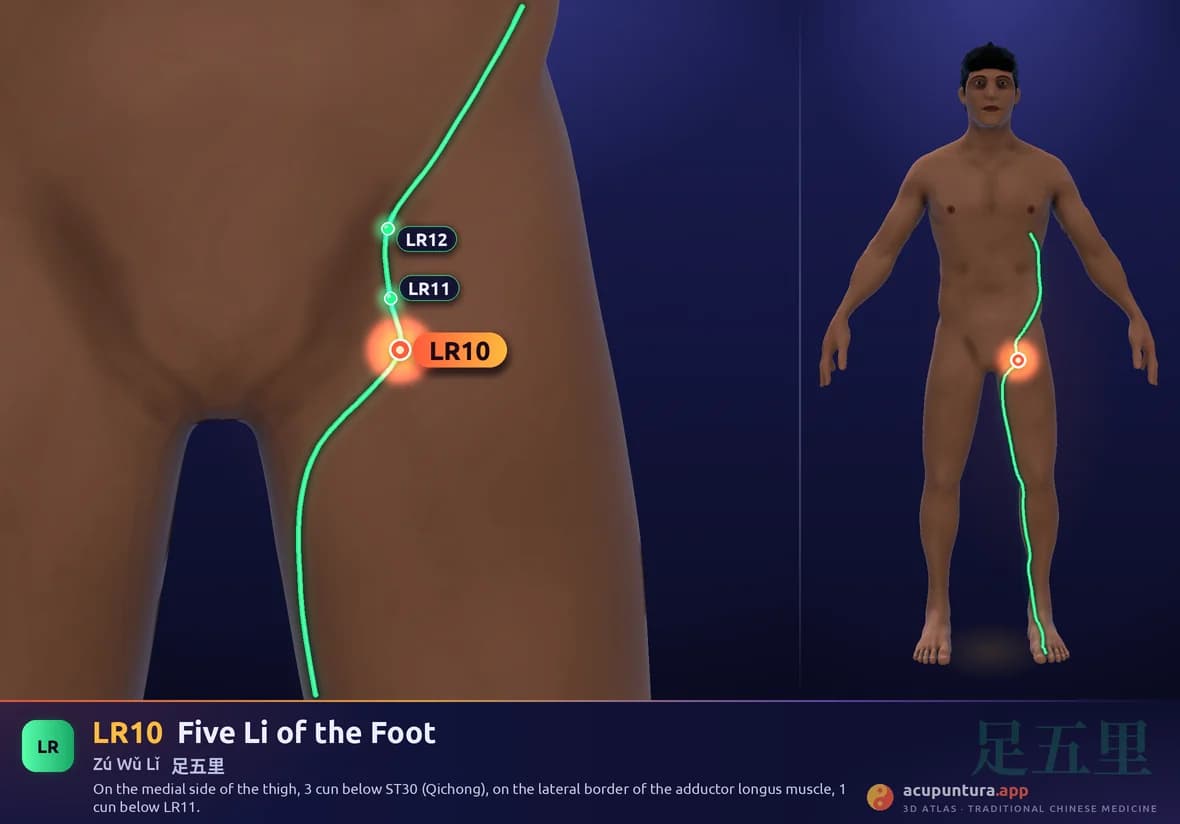
Liver Channel
Five Li of the Foot
足五里Zú Wǔ LǐAnatomical location
On the medial side of the thigh, 3 cun below ST30 (Qichong), on the lateral border of the adductor longus muscle, 1 cun below LR11.
Main function
Regulates the Liver, benefits the Lower Jiao, relieves pain.
Therapeutic indications
- Groin pain
- dysmenorrhea
- leukorrhea
- dysuria
- abdominal pain
- hypogastric distension and pain
- urinary retention
- genital itching
- drowsiness
Name and classical tradition
Zuwuli, 足五里, is the “Wuli of the foot,” and its name is one more case of disambiguation. In the Zhenjiu Jiayi Jing (Systematic Classic of Acupuncture and Moxibustion) it was called simply 五里, just like LI13, the Wuli of the arm. In the Song period, according to the sources, the Shengji Zonglu (Comprehensive Recording of Divine Assistance) added 足, “foot,” to tell them apart. It is the same process that separated ST36 from LI10, although in this case the quotations from both works have not been verified.
五里 literally means “five li,” a unit of distance, but in point names it is rarely used as a literal measure. Some glosses understand 里 as the dwelling, the place where Qi resides; others speak of an area of influence of five li. Neither has a classical basis. The Zhenjiu Jiayi Jing only gives its location: “在陰廉下,去氣沖三寸,” below LR11, Yinlian, three cun from ST30, Qichong.