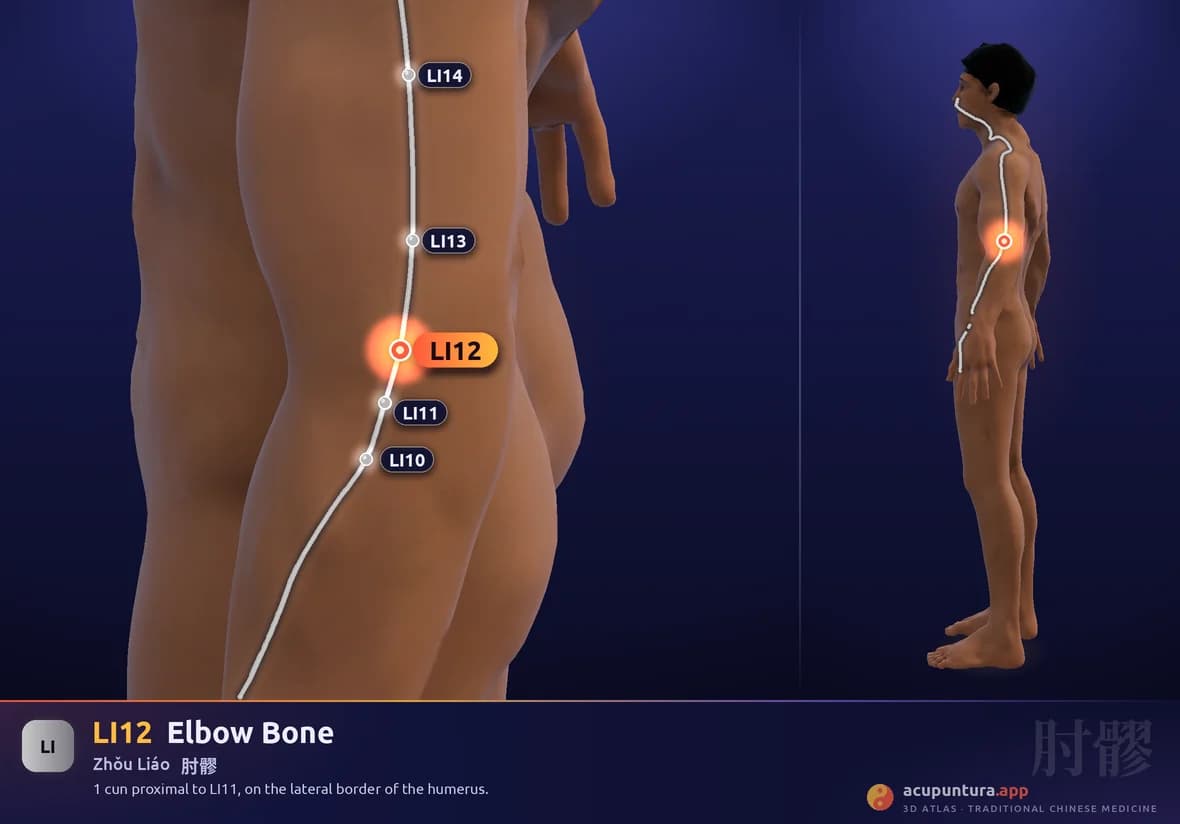
Large Intestine Channel
Elbow Bone
肘髎Zhǒu LiáoAnatomical location
1 cun proximal to LI11, on the lateral border of the humerus.
Main function
Disperses Wind-Dampness, relieves elbow pain.
Therapeutic indications
- Elbow pain
- stiff neck
- shoulder pain
- elbow contracture
- numbness of the forearm
- epicondylitis
- limited elbow extension
Name and classical tradition
Zhouliao, 肘髎, is the “elbow crevice.” The usual translation, “elbow bone,” oversimplifies: 髎 does not mean bone but the hollow or fissure beside a bone, and it is the character the nomenclature uses for points located in bony depressions. Zhouliao lies at the edge of the supracondylar ridge of the humerus, one cun above LI11, Quchi, in that small hollow beside the bone.
The sources trace it to the Zhenjiu Jiayi Jing (Systematic Classic of Acupuncture and Moxibustion), with no literal citation located, and record the graphic variant 肘聊. No classical commentaries or historical anecdotes are known for it. It shares the 髎 with other points across the body, such as GB1, beside the eye, or LI19, beside the mouth, which likewise name a hollow in the bone.