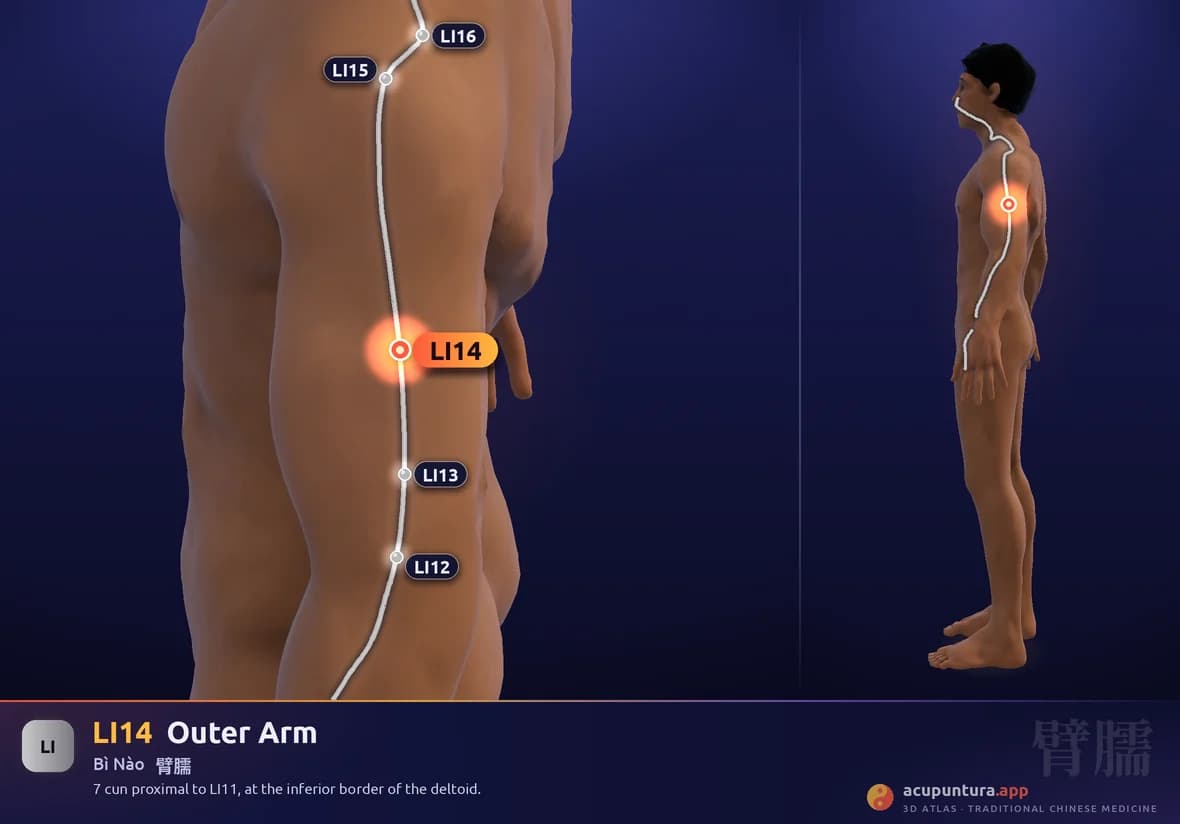
Large Intestine Channel
Outer Arm
臂臑Bì NàoAnatomical location
7 cun proximal to LI11, at the inferior border of the deltoid.
Main function
Disperses Wind-Dampness, relieves shoulder pain.
Therapeutic indications
- Shoulder pain
- neck stiffness
- visual disorders
- Scrofula
- Eye disorders
- Cervical stiffness
- Inability to raise the arm
- Deltoid pain
Name and classical tradition
Binao, 臂臑, combines 臂, the arm, and 臑, an ancient character that designated the fleshy part of an animal's arm or thigh, the muscle mass near the joint. The name is therefore anatomical: the point lies in the flesh of the arm, on the anterior border of the deltoid. Some modern sources add to 臑 a nuance of agility and movement, which has no classical citation.
The alternative names are varied: 頭沖, 頸沖, 背臑 and the graphic variant 臂脑. The first two, "impulse of the head" and "of the neck," are explained in modern reference works by the point's use in conditions of the head and neck, areas the channel ascends to, rather than by any feature of its location. The attribution of these aliases to an ancient work remains to be verified. The sources trace the point to the Zhenjiu Jiayi Jing (Systematic Classic of Acupuncture and Moxibustion) and regard it as a meeting place of the channel with its collateral.