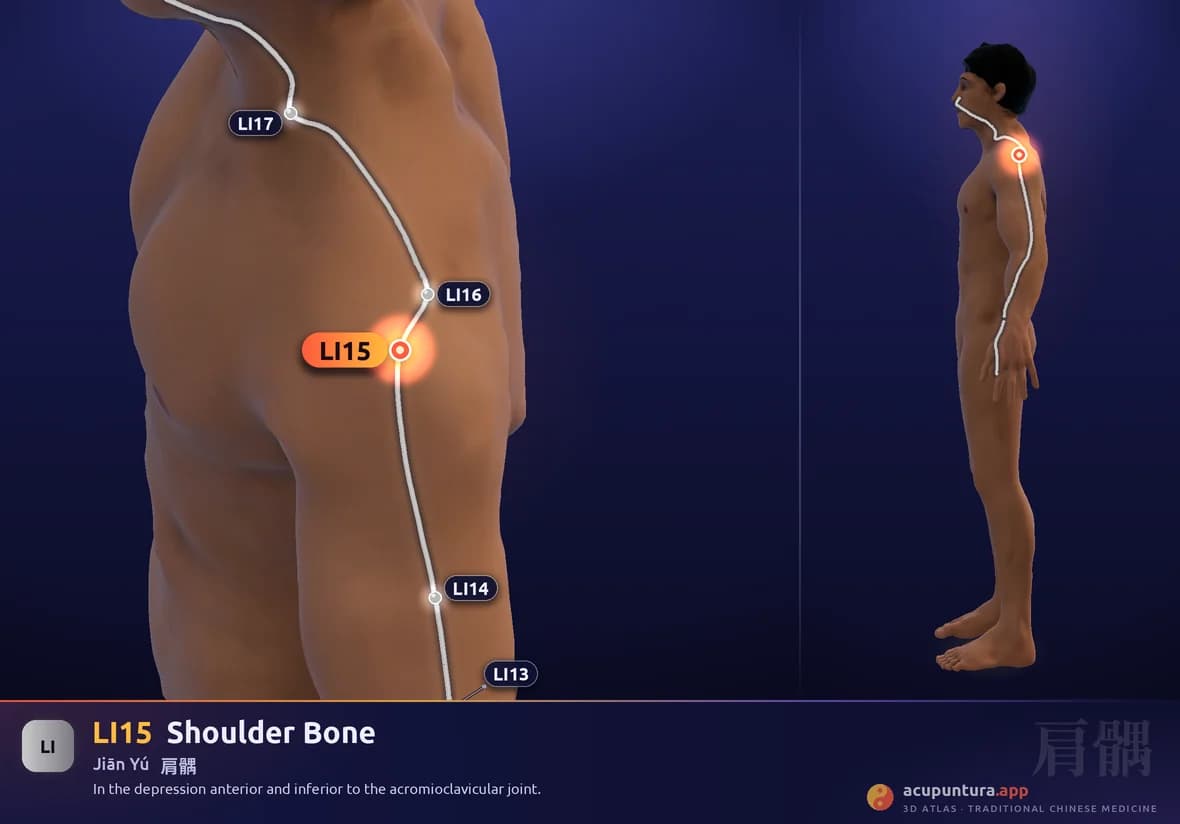
Large Intestine Channel
Shoulder Bone
肩髃Jiān YúAnatomical location
In the depression anterior and inferior to the acromioclavicular joint.
Main function
Disperses Wind-Dampness, benefits the shoulder, relieves pain.
- Crossing point with the Yang Wei and Yang Qiao
Therapeutic indications
- Shoulder pain
- arm paralysis
- hives
- Scapulohumeral periarthritis
- Frozen shoulder
- Hemiplegia
- Pruritus
- Hypertension
- Scrofula
- Limited abduction
Name and classical tradition
Jianyu, 肩髃, is the "corner of the shoulder." 肩 is the shoulder, and in classical anatomy 髃 designates a prominent bony angle, specifically the anterior tip of the acromion, the end of the scapula. The name describes the location without metaphor: the point lies in the depression that opens beneath that bony corner when the arm is raised.
The list of alternative names is long and almost entirely anatomical: 髃骨, 扁骨, 偏骨, 尚骨, 偏肩 and 中肩井. The last one should be read with care, because GB21, Jianjing, is a different point on the Gallbladder channel, and the prefix 中 might express a positional relationship between the two, which remains to be verified.
The sources trace it to the Zhenjiu Jiayi Jing (Systematic Classic of Acupuncture and Moxibustion) and regard it as a meeting point of the channel with the Yangqiao vessel, like its neighbor LI16.