Liver Channel
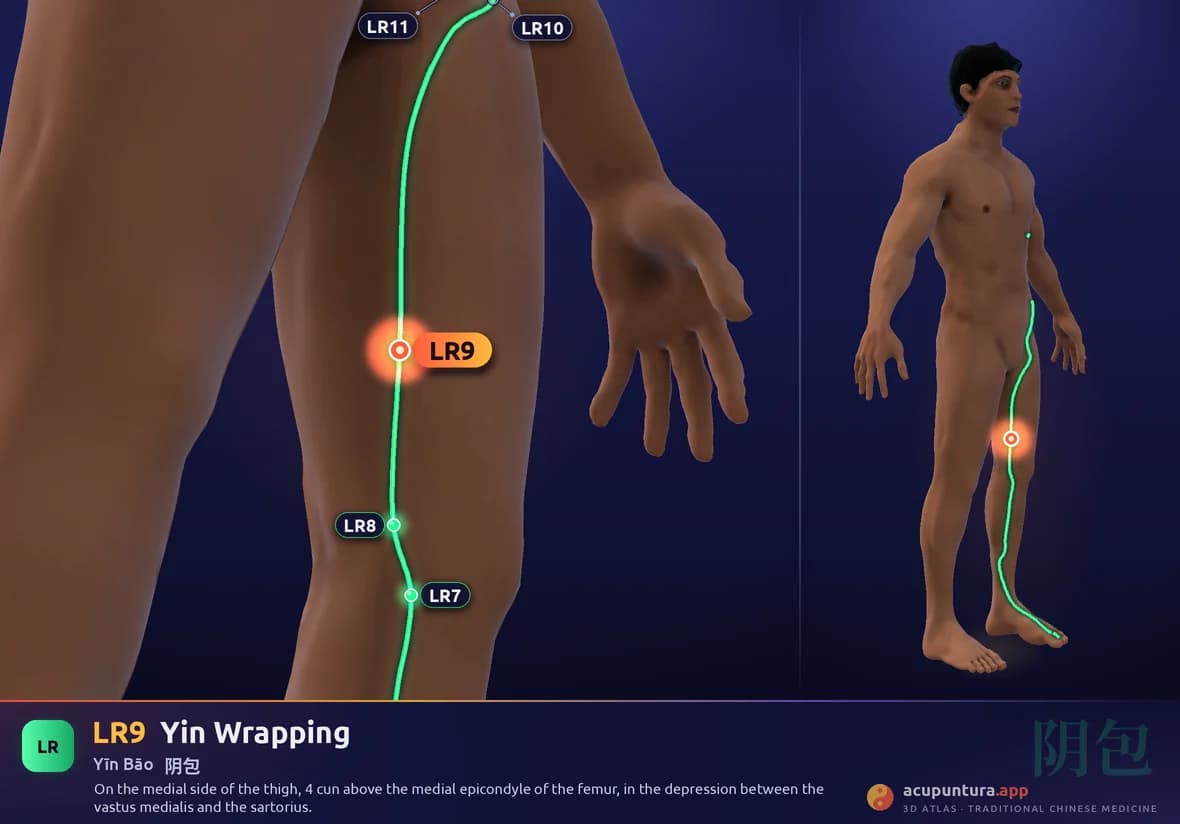
Yin Wrapping
阴包Yīn BāoAnatomical location
On the medial side of the thigh, 4 cun above the medial epicondyle of the femur, in the depression between the vastus medialis and the sartorius.
Main function
Regulates the Liver, benefits the Lower Jiao, relieves pain.
Therapeutic indications
- Groin pain
- dysmenorrhea
- metrorrhagia
- leukorrhea
- abdominal pain
- irregular menstruation
- lumbosacral pain
- dysuria
- enuresis
- hypogastric pain
Name and classical tradition
Yinbao, 阴包, combines 阴 (陰), the inner side of the thigh, and 包, a character with two readings. In the first, 包 would be a form of 胞, the bladder or the uterus, and the name would allude to the point’s indications in urinary and menstrual disorders. In the second, 包 means to wrap, to contain, and the point would gather the Yin Qi of the channel. Both coexist in the sources, and neither has strong philological support. In favor of the first, the Zhenjiu Dacheng (Great Compendium of Acupuncture and Moxibustion) records the alias 陰胞, with 胞 in place of 包, and the Zisheng Jing notes that the Mingtang wrote it that way; even so, it is an inference.
The Zhenjiu Jiayi Jing (Systematic Classic of Acupuncture and Moxibustion), in book 3, locates it thus: “陰包,在膝上四寸股內廉兩筋間,” four cun above the knee, on the inner side of the thigh, between two tendons. It is needled six fen deep and given three moxa cones. The same ambiguity of 胞 appears in BL53, Baohuang.