Liver Channel
Spring at the Bend
曲泉Qū QuánAnatomical location
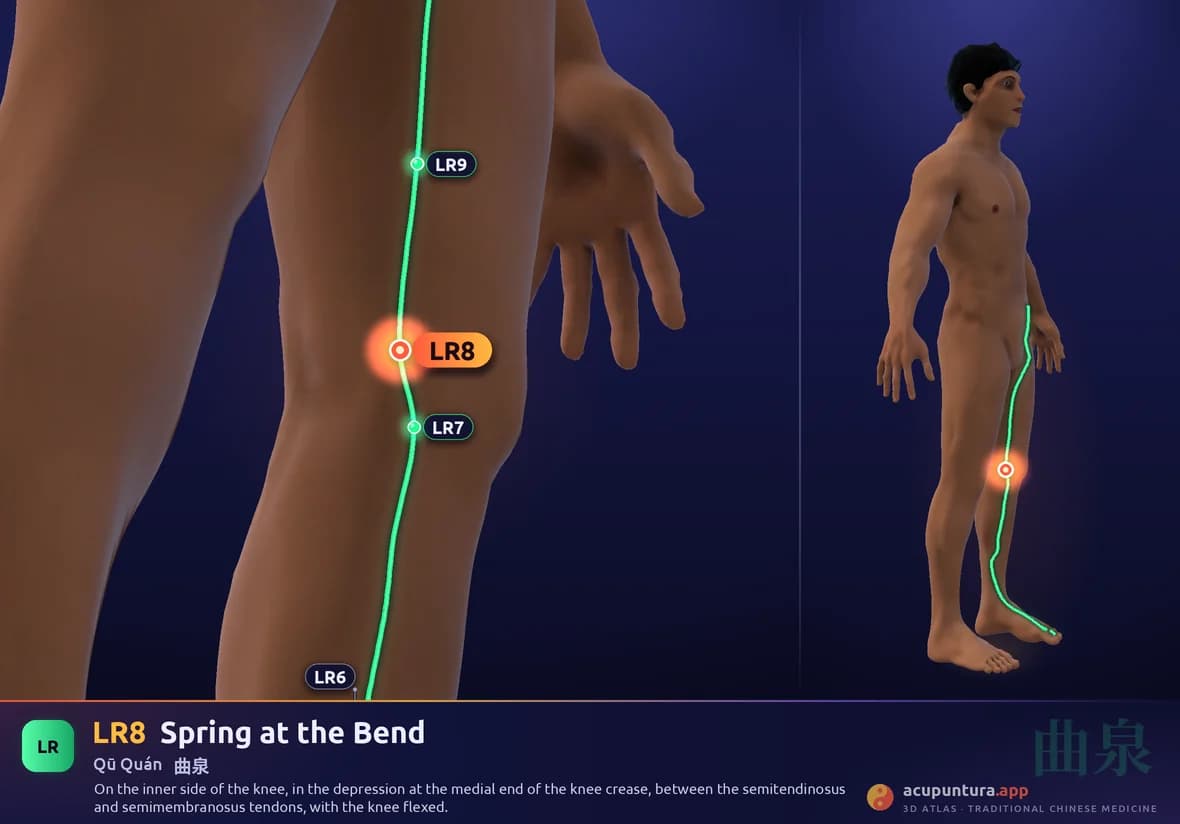
On the inner side of the knee, in the depression at the medial end of the knee crease, between the semitendinosus and semimembranosus tendons, with the knee flexed.
Main function
He-Sea point (Water), tonification point, nourishes Liver Yin, benefits the Lower Jiao, regulates urination and menstruation.
- He-Sea point (Water)
- Tonification Point
Therapeutic indications
- Dysmenorrhea
- amenorrhea
- leukorrhea
- genital itching
- dysuria
- groin pain
- uterine prolapse
- fatigue
- genital itching and pain
- urinary retention
- knee pain
- impotence
- nocturnal emission
- infertility
- dry eyes
- hypogastric pain
- Parkinson's disease (tremor due to Internal Wind)
- endometriosis
Ryodoraku
- Tonification of Liver
Name and classical tradition
Ququan, 曲泉, is the “spring of the bend.” 曲 means to bend, to curve; 泉, the spring. The 曲 refers directly to the posture needed to find the point, as the Lingshu (Spiritual Pivot) itself says in the Ben Shu chapter (本輸): “入於曲泉,輔骨之下,大筋之上也,屈膝而得之,為合。足厥陰也”. The Qi enters at Ququan, below the supporting bone and above the great sinew; you find it with the knee bent; it is the He point; such is the Foot Jueyin. The name and the method of location agree.
It is the He-Sea point (合穴) of the Liver, which on the Yin channels corresponds to Water, and it closes the sequence of the five transport points of the channel, which began at LR1. The Liver is Wood, and Water generates Wood, so the tradition has regarded it as the Liver’s mother point.
The character 泉 is shared by other points that have no relation to it, such as SP9, Yinlingquan, KI1, Yongquan, or HT1, Jiquan. Some modern sources give it “aliases” such as 肝經合 or 合水穴, which are not ancient names but descriptions of its function.