CV17

Ren Mai (Conception Vessel) Channel

Center of the Thorax

膻中Dàn Zhōng

Anatomical location

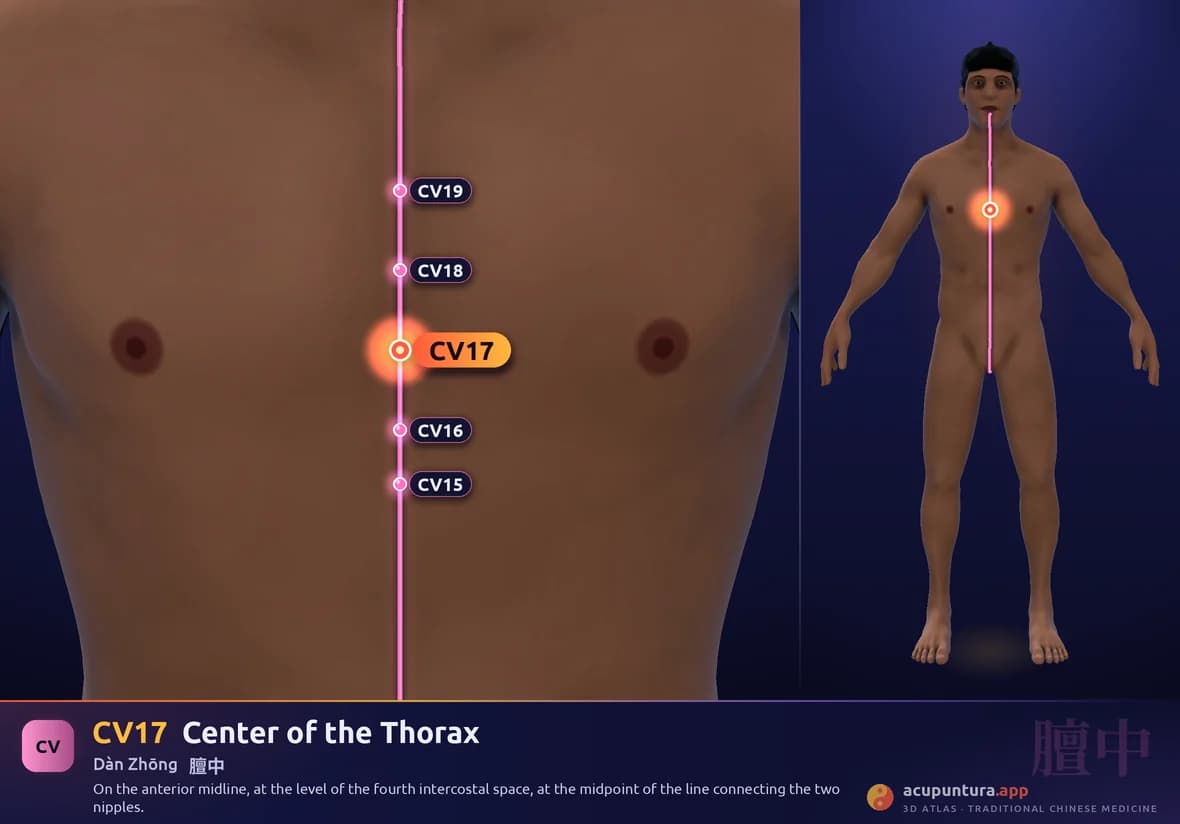
On the anterior midline, at the level of the fourth intercostal space, at the midpoint of the line connecting the two nipples.

Main function

Regulates the Qi of the chest, benefits the Lung and Heart.

  • Front-Mu point of the Pericardium
  • Influential (Hui) Point of Qi
  • Sea of Qi point
  • Crossing point with the Spleen, Kidney, Small Intestine, and Triple Energizer

Therapeutic indications

  • Chest pain
  • cough
  • asthma
  • palpitations
  • insufficient lactation
  • dyspnea
  • chest oppression and pain
  • mastitis
  • scanty milk
  • hiccups
  • distress
  • difficulty swallowing
  • panic attacks (Ben Tun Qi)
  • depression
  • COPD and chronic bronchitis
  • low blood pressure
  • premenstrual syndrome

Name and classical tradition

Danzhong, 膻中, is the "Center of the Chest." 膻 is a rare character, which here designates the space of the thorax; 中 is the center. The point lies on the sternum, between the two nipples, and the modern gloss describes it as the place that represents the heart outwardly and transmits its orders (代心布令).

The most important quotation is from the Lingshu (Spiritual Pivot), in the chapter Hai Lun (海論), on the four seas of the body: "膻中者,為氣之海," Danzhong is the sea of Qi. Hence its alias 上氣海, "upper sea of Qi," to distinguish it from CV6, Qihai, the lower one; Zhang Jiebin, in the Leijing Tuyi (Illustrated Supplement to the Classified Classic), records that name, according to the sources. The Suwen (Basic Questions), in the chapter Ling Lan Mi Dian Lun, also presents it as the "minister and envoy" of the heart, "膻中者,臣使之官," the phrase that explains the name of PC5, Jianshi. The sources disagree on whether the point's name comes from the Lingshu or from the Nanjing (Classic of Difficulties).

Danzhong is the Front-Mu point (募穴) of the Pericardium and the Influential (Hui) point of Qi (氣會) among the Eight Influential Points. The reference works also record the alias 胸堂, "hall of the chest."

Other names

  • 元兒Jiayi Jing
Location of point CV17, Center of the Thorax
CC BY-ND 4.0 (opens in a new tab)
View point on the 3D modelCV17 on the anatomy
Needling techniqueOblique or subcutaneous insertion 0.3-0.5 cun.
Depth0.3-0.5 cun
MoxibustionApplicable (3-5 cones or 5-10 minutes, indirect moxa)
PrecautionsAvoid deep needling so as not to injure the heart or lungs.

Classical combinations · 2

  • The Eight Influential Points八会穴Bā Huì XuéInfluential (Hui) point of each substance or tissue: Zang LR13, Fu CV12, Qi CV17, Blood BL17, tendons GB34, vessels LU9, bones BL11, marrow GB39.
  • Descend rebellious Lung QiInfluential (Hui) point of Qi with the He-Sea point of the Lung: descends rebellious Qi and loosens the chest.

Basic formulas from the vademecum · 4

View the vademecum

Named functional sets from the school: here the point does not act on its own, but through the role it plays within the maneuver.

  • Meeting of EnergiesThe three Mu points of the central axis, one for each Jiao: CV17 for the Qi of the chest, CV12 for the Center, and CV5, the Front-Mu point of the Triple Energizer, in the lower abdomen. It gathers the Qi of the three cavities into a single treatment.
  • Tonify EnergyRaises the Qi from its root to its summit: GV4 and BL23 kindle the Mingmen, CV6 is the sea of Qi, CV12 and ST36 produce the acquired Qi, and CV17 gathers it in the chest.
  • Decongest the ChestFrees the Upper Jiao: CV22 at the throat and CV17 as the Influential (Hui) point of Qi in the middle of the sternum.
  • Tonify the Upper JiaoShu-Mu technique for the chest: CV17 as the Front-Mu point of the Pericardium and Influential point of Qi, with the Back-Shu points of the Lung (BL13), Pericardium (BL14), and Heart (BL15).
Cover of the guide “Protocols for the 20 most common patterns”

Free guide · PDF

Protocols for the 20 patterns you see most in practice

Each pattern with its tongue, its pulse, the treatment principle and the points to tonify and disperse. Made for the treatment table, not the bookshelf.

Do you use CV17 with your patients?

In the Clinic you record it in the patient's file, next to the tongue, the pulse and the measurements, so at the next session you know exactly what you used. The Atlas is built in.

See the Clinic