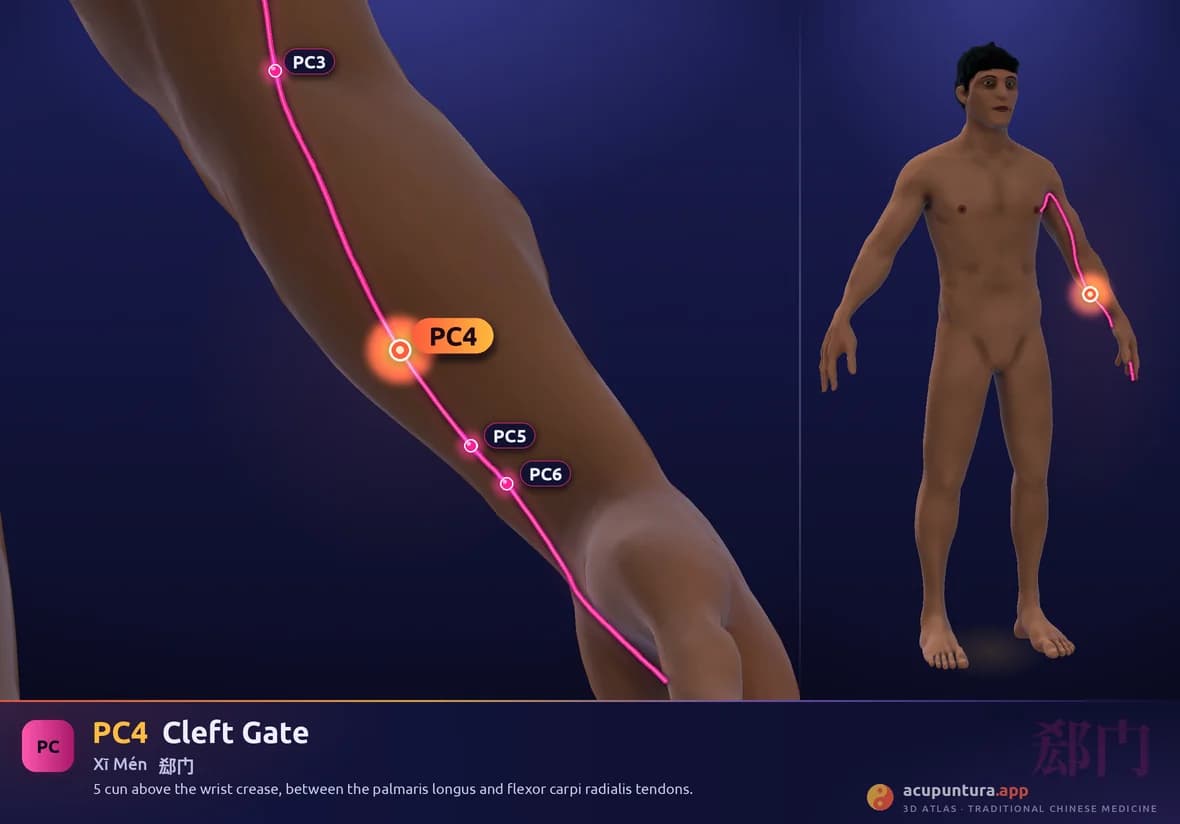
Pericardium Channel
Cleft Gate
郄门Xī MénAnatomical location
5 cun above the wrist crease, between the palmaris longus and flexor carpi radialis tendons.
Main function
Regulates Qi and Blood, calms the Shen, relieves chest pain.
- Xi-Cleft point
Therapeutic indications
- Chest pain
- palpitations
- hemoptysis
- anxiety
- acute cardiac pain
- epistaxis
- fear
- mastitis
- furuncles
- night sweats
- angina pectoris
Name and classical tradition
Ximen, 郄門, is the “gate of the cleft.” 郄 is a technical term: it designates the category of Xi-Cleft points (郄穴), places where the Qi and Blood of the channel gather deep, and to which the tradition turns in acute conditions. 門 is the gate. The name therefore announces the function: this is the Xi-Cleft point of the Pericardium. The image of a double door between the radius and the ulna, which some manuals add, is a modern gloss.
Unlike the transport points of the channel, Ximen does not appear in the Ben Shu chapter of the Lingshu (Spiritual Pivot). Its first mention is in the Zhenjiu Jiayi Jing (Systematic Classic of Acupuncture and Moxibustion) by Huangfu Mi, which defines it precisely: «郄門,手心主郄,去腕五寸», Ximen, Xi-Cleft point of the Heart Master (the Pericardium), five cun from the wrist. In the section on indications, the same work assigns it one: «咳血,大陵及郄門主之», coughing of blood is treated by Daling and Ximen. That combination with PC7 for a hemorrhage is consistent with the use of Xi-Cleft points in acute Blood disorders.