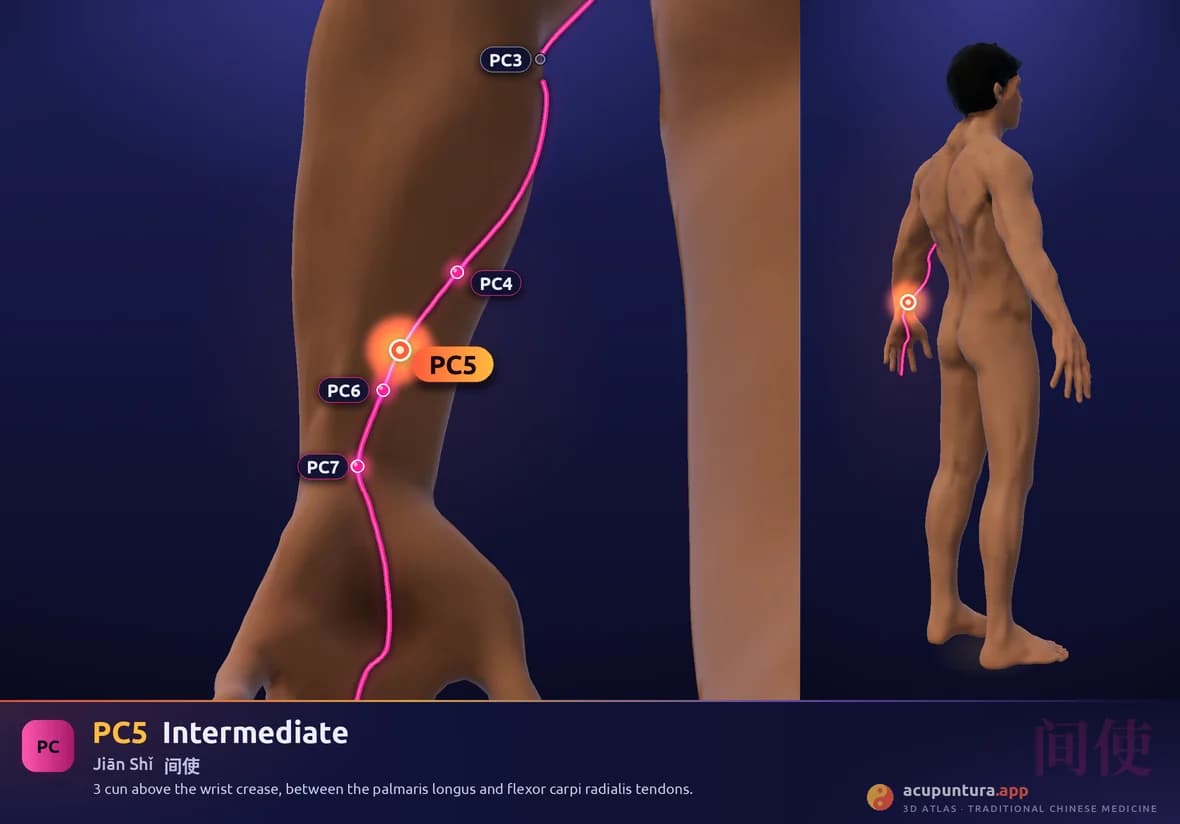
Pericardium Channel
Intermediate
间使Jiān ShǐAnatomical location
3 cun above the wrist crease, between the palmaris longus and flexor carpi radialis tendons.
Main function
Regulates Heart Qi, calms the Shen, harmonizes the Stomach.
- Jing-River point (Metal)
Therapeutic indications
- Palpitations
- chest pain
- epilepsy
- anxiety
- Mania
- Malaria
- Vomiting
- Epigastric fullness
- Amenorrhea
- Stiff tongue
- Aphonia
- Schizophrenia (Dian Kuang)
Name and classical tradition
Jianshi, 間使, is the “emissary of the interval.” 間 means an in-between space, an interstice, and the Lingshu (Spiritual Pivot) itself places the point «兩筋之間», between the two tendons. 使 is the envoy, the emissary. To explain this second character, the soundest reading points to the Suwen (Basic Questions), chapter Ling Lan Mi Dian Lun (靈蘭秘典論), which describes the organs as officials of a court: «膻中者,臣使之官,喜樂出焉». The Danzhong region, associated with the Pericardium, is the minister-emissary, from whom joy and pleasure emerge. The point would then be the emissary of that minister channel. The quotation is genuine; applying it to the name of the point is a later association.
In the Ben Shu chapter (本輸), the Lingshu gives it a singular description: «行於間使,間使之道,兩筋之間,三寸之中也,有過則至,無過則止,為經». Qi travels through Jianshi, in the passage between the two tendons, at three cun; when something is wrong, it arrives; when nothing is wrong, it stops. It is the Jing-River point (經穴), which in the Yin channels corresponds to Metal. The phrase «有過則至,無過則止» is one of the few functional glosses that the Ben Shu includes within the text itself, not a later addition.
There is another, modern reading that interprets 間使 as “to make something act indirectly,” with an explanation about the water of Qi cooling down. It has no classical source.