Pericardium Channel
Great Mound
大陵Dà LíngAnatomical location
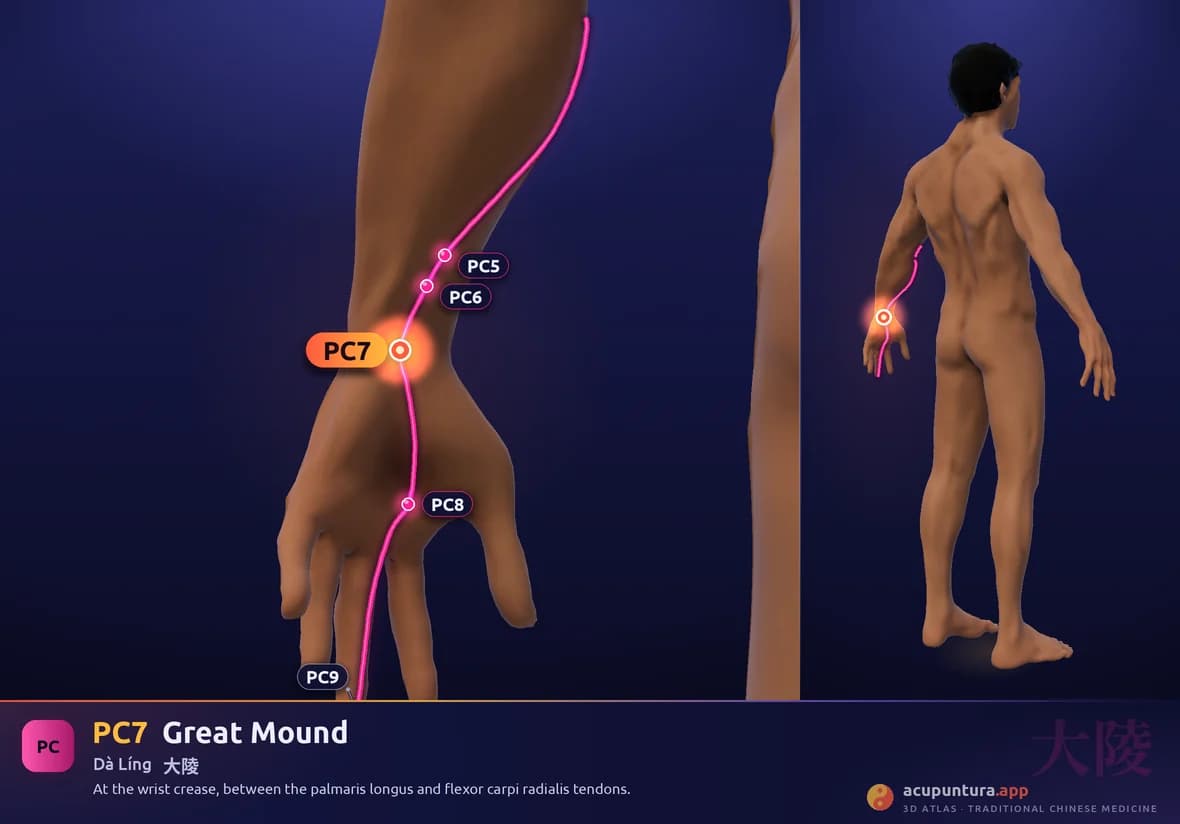
At the wrist crease, between the palmaris longus and flexor carpi radialis tendons.
Main function
Calms the Shen, regulates Heart Qi, relieves pain.
- Yuan (Source) point
- Shu-Stream point (Earth)
- Sedation Point
- Ryodoraku point H2 (Pericardium)
Therapeutic indications
- Palpitations
- chest pain
- anxiety
- insomnia
- Mania
- Weakness and pain of the wrist
- Carpal tunnel syndrome
- Halitosis
- Stomatitis
- Stomach pain
- Vomiting
- Heat in the palms
Ryodoraku
H2PericardioMeasurement point no. 9
Yuan-Source point of the Pericardium, at the center of the wrist crease.
- Sedation of Pericardium
Name and classical tradition
Daling, 大陵, is the “great mound.” 大 is great, and 陵 a mound of earth. The usual explanation, modern but plausible anatomically, is that the point lies at the wrist, on the relief formed by the carpal bones between the tendons. It is the same word the Gallbladder channel uses at GB34, the “yang mound.”
The Lingshu (Spiritual Pivot), in the Ben Shu chapter (本輸), locates it as follows: «注於大陵,大陵,掌後兩骨之間方下者也,為俞», Qi pours into Daling, behind the palm, just below the area between the two bones; it is the Shu-Stream point. In the Yin channels, the Shu-Stream point (輸穴) coincides with the Yuan-Source point (原穴), and corresponds to Earth. The Zhenjiu Jiayi Jing (Systematic Classic of Acupuncture and Moxibustion), according to secondary sources, writes it 太陵, with 太 in place of 大, a common graphic variant between characters of similar meaning.
The reference works attribute two alternative names to it. 鬼心 refers to Sun Simiao's thirteen ghost points, but the edition of the Qianjin Yaofang (Essential Formulas Worth a Thousand Gold) that was consulted identifies that Guixin with LU9, Taiyuan, and not with Daling, so the attribution to this point is doubtful. 心主 is more striking: it is the same term the Lingshu uses to name the entire channel. If it was really used as a name for the point, it would be the Yuan-Source point taken for the whole; it could also be a modern confusion between the name of the channel and that of the point. Neither possibility can be taken as certain.