Spleen Channel
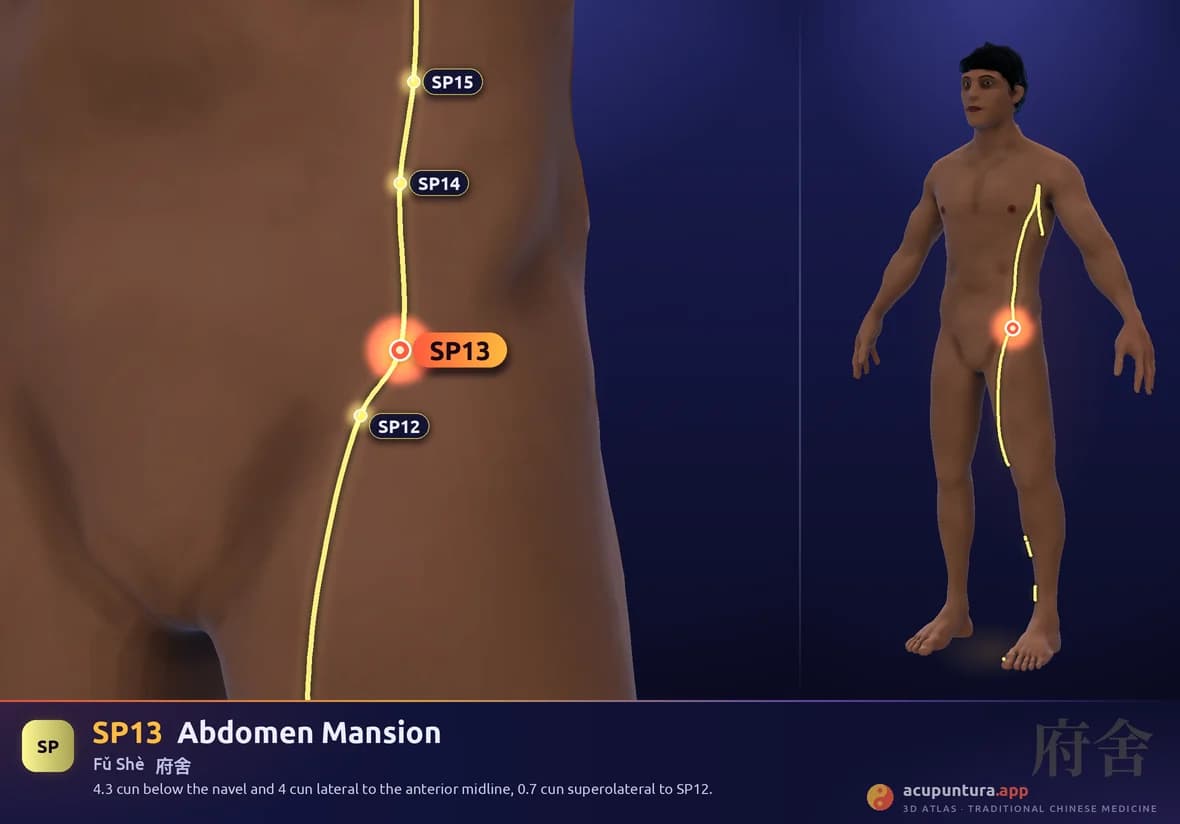
Abdomen Mansion
府舍Fǔ ShèUse caution during pregnancy
Lower abdomen, crossing point with the Yin Wei Mai; avoid deep needling.
Anatomical location
4.3 cun below the navel and 4 cun lateral to the anterior midline, 0.7 cun superolateral to SP12.
Main function
Regulates the Qi of the Lower Jiao, strengthens the Spleen, relieves pain.
- Crossing point with the Chong Mai
- Crossing point with the Yin Wei Mai
Therapeutic indications
- Abdominal pain
- diarrhea
- constipation
- hernia
- abdominal masses
Name and classical tradition
Fushe, 府舍, combines 府, the Fu organs, the internal storehouses, and 舍, the dwelling, the place something comes from. A modern gloss understands that the Qi and Blood of the point come from the Fu organs deep inside, through the Yin Wei Mai, which brings fluids from within. This is the usual interpretation, but it has no classical citation.
The point is a crossing of three pathways: the Spleen channel itself, the Liver channel, and the Yin Wei Mai. This is well established in the tradition, although sources refer it back to the Zhenjiu Jiayi Jing (Systematic Classic of Acupuncture and Moxibustion) without a literal citation.
It should not be confused with 脾舍, “Dwelling of the Spleen,” an alternative name for SP8, Diji. The two names share 舍 and a similar meaning, but they designate different points, one on the leg and the other on the lower abdomen.