Spleen Channel
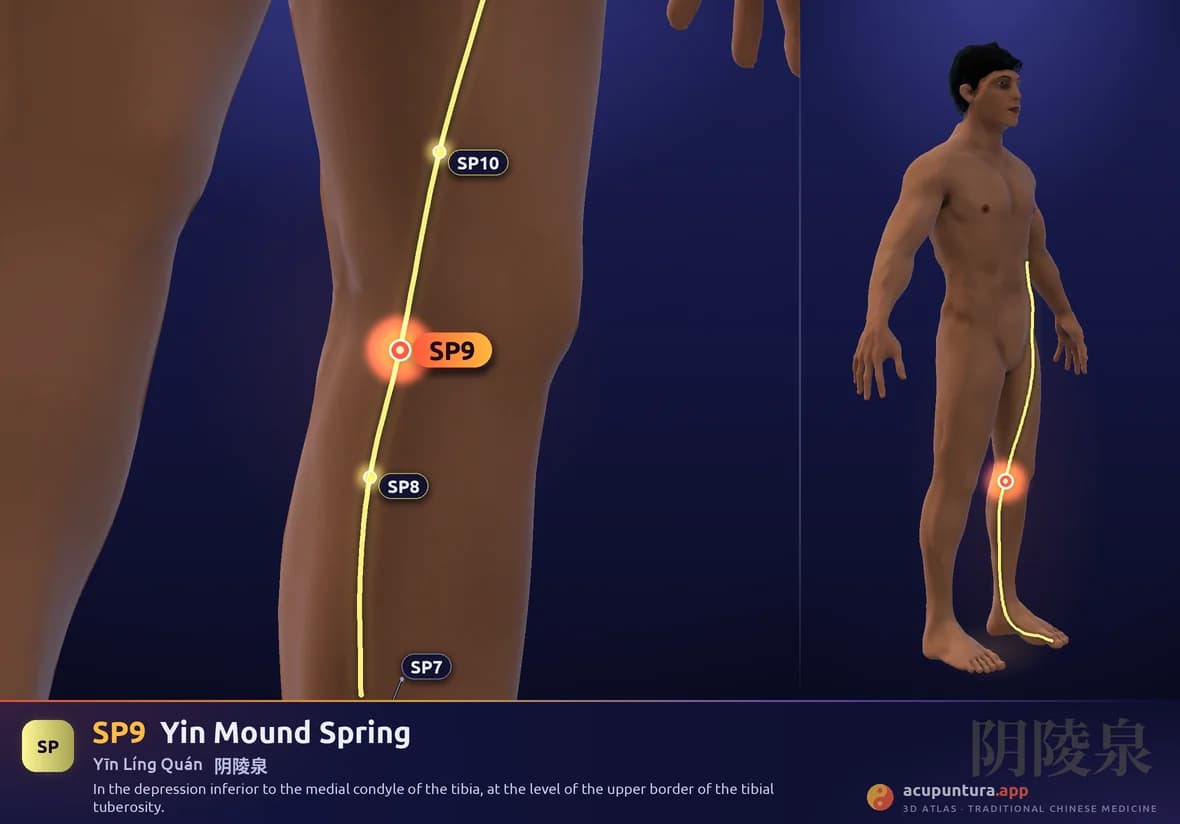
Yin Mound Spring
阴陵泉Yīn Líng QuánAnatomical location
In the depression inferior to the medial condyle of the tibia, at the level of the upper border of the tibial tuberosity.
Main function
Strengthens the Spleen, eliminates Dampness, promotes diuresis.
- He-Sea point (Water)
Therapeutic indications
- Edema
- dysuria
- diarrhea
- knee pain
- jaundice
- Urinary retention
- Incontinence
- Abdominal distension
- Knee pain
- Leukorrhea
- Genital pain
- Heaviness of the body
- Ascites
- Diabetes mellitus (Xiao Ke)
- Obesity and overweight
- Hyperlipidemia (high cholesterol and triglycerides)
- Hyperuricemia and gout
- Kidney stones and renal colic
- Venous insufficiency and varicose veins
- Prostatitis and benign prostatic hyperplasia
- Polycystic ovary syndrome
- Knee osteoarthritis
Name and classical tradition
Yinlingquan (阴陵泉) is the “spring of the Yin mound,” and its original name was even more explicit. The Lingshu (Spiritual Pivot), in the Ben Shu (本輸) chapter, calls it 陰之陵泉, “the spring of the mound of the Yin,” with the particle 之 that was later lost: “入於陰之陵泉,陰之陵泉,輔骨之下,陷者之中也,伸而得之,為合”. Qi enters Yinzhilingquan, below the supporting bone, in the depression; it is found with the leg extended; it is the He-Sea point.
The name is an anatomical description. 阴 is the inner, Yin side of the knee; 陵, the mound, the relief of the medial condyle of the tibia; 泉, the spring that wells up in the depression beneath it. The Ben Shu text itself, with its “陷者之中”, in the middle of the depression, confirms the image. As the He-Sea point of a Yin channel, it corresponds to Water.
On the outer side of the knee, the Gallbladder channel has its exact counterpart, GB34, Yanglingquan, the “spring of the Yang mound,” beneath the head of the fibula. The Ben Shu calls that point 陽之陵泉, and the symmetry between the two names is complete.