Stomach Channel
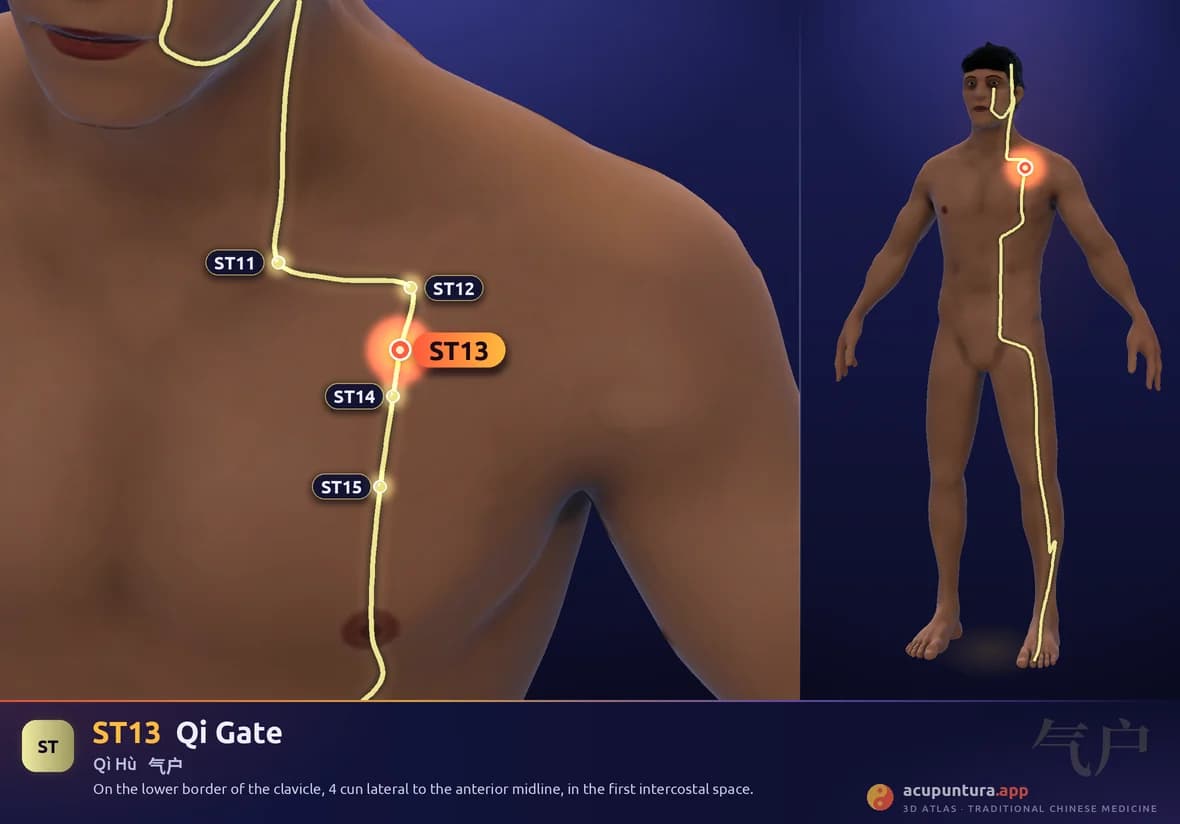
Qi Gate
气户Qì HùAnatomical location
On the lower border of the clavicle, 4 cun lateral to the anterior midline, in the first intercostal space.
Main function
Regulates Qi, descends rebellious Qi, benefits the chest, relieves cough and asthma.
Therapeutic indications
- Cough
- asthma
- chest pain
- shoulder pain
- dyspnea
- chest pain and fullness
- hiccups
Name and classical tradition
Qihu, 气户, is the “door of Qi.” 戶, unlike 門, designates a single-leaf door, that of a house rather than a city. The point lies below the clavicle, and the reasonable reading is that the Qi of the upper chest enters and leaves through here. Already in the Jiayi Jing it serves as a reference for locating LU2, Yunmen, “two cun on either side of Qihu.”
The most interesting thing about the name is that it opens a series. In its descent through the chest, the Stomach channel strings together four names taken from architecture: Qihu, the door; ST14, Kufang, the storehouse; ST15, Wuyi, the inner chamber; and ST16, Yingchuang, the window of the chest. Moving through these points is like entering a house. No ancient commentator explicitly describes the series, but the coherence of the names is evident. Its first documented mention is in the Zhenjiu Jiayi Jing (Systematic Classic of Acupuncture and Moxibustion) of Huangfu Mi.