Stomach Channel
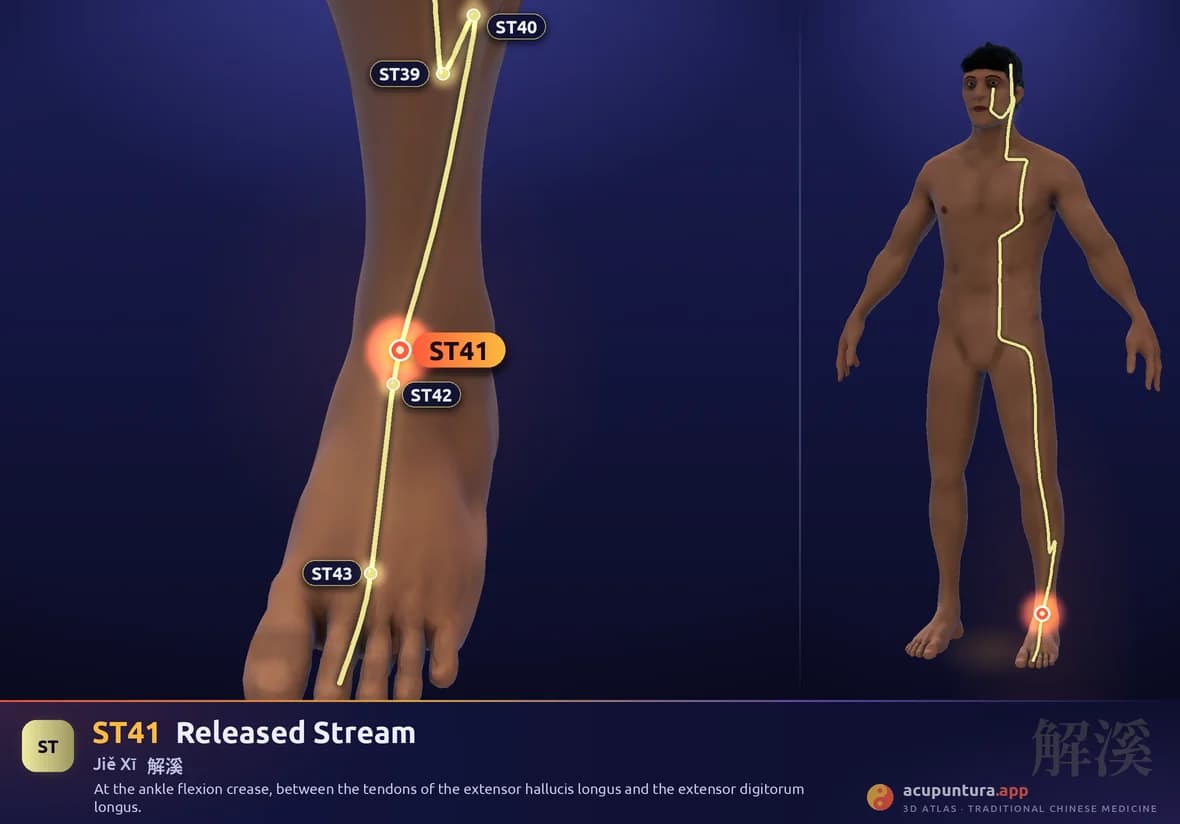
Released Stream
解溪Jiě XīAnatomical location
At the ankle flexion crease, between the tendons of the extensor hallucis longus and the extensor digitorum longus.
Main function
Disperses Wind-Dampness, benefits the ankle, descends rebellious Qi.
- Jing-River point (Fire)
- Tonification Point
Therapeutic indications
- Ankle pain
- foot pain
- headache
- dizziness
- insomnia
- ankle pain and swelling
- ankle sprain
- foot drop
- headache
- abdominal distension
- constipation
- mania
- facial edema
- hyperuricemia and gout
- rheumatoid arthritis
Ryodoraku
- Tonification of Stomach
Name and classical tradition
Jiexi, 解溪, combines 解, “to untie,” “to release,” and also, in the anatomical sense, the joint that bends, with 溪, the stream, the small watercourse. There are two possible readings. One is functional: the water of the channel is untied here and dispersed. The other is anatomical: it is the point at the ankle joint where the channel runs. Both are reasonable and consistent with the water nomenclature of the Five Shu points, although neither has an ancient author.
The Lingshu (Spiritual Pivot), in the chapter Ben Shu (本輸), establishes it as the Jing point (經穴) of the Stomach channel, which in the Yang channels corresponds to Fire. The point lies in the ankle crease, between the tendons, right at the joint that the 解 of the name might be pointing to. In the sequence of the Five Shu points, it precedes ST36, the He-Sea point.